

A real, no-fluff guide to sustainable fat loss — backed by lived experience and honest science
Why I Finally Stopped Searching and Started Doing
March 4th, 2024. I stepped on the bathroom scale, stared at the number, and felt that familiar mix of embarrassment and exhaustion. Not because I was shocked — I knew exactly how I’d gotten there. Nine months of stress eating, skipped workouts, and convincing myself I’d ‘start fresh on Monday.’ The number read 187 pounds. My goal was 175. And summer was twelve weeks away.
Here is what I did not do: I did not buy a detox tea. I did not join a $300-per-month bootcamp. I did not download my fourteenth fitness app and abandon it by Thursday.
Instead, I built a simple, honest plan — and I lost exactly 10.4 pounds in 11 weeks. Not because I have elite willpower or a fast metabolism. But because I stopped trying to be perfect and started trying to be consistent. This is the exact plan I followed, the mistakes I made along the way, and the tools that actually helped.
Quick note: I am not a certified dietitian. Before making significant changes to your diet or exercise routine, consult a qualified healthcare professional. That said, everything in this article is grounded in well-established research and personal experience.
The One Mindset Shift That Changed Everything
Most people approach weight loss like a sprint. They slash 1,000 calories overnight, wake up for 5 a.m. runs, and white-knuckle their way through a week before collapsing into a pizza-and-Netflix Saturday.
I know because I had done that exact thing in 2021 and again in 2022. Both times, I lost a few pounds and gained them all back within six weeks. The problem was never the plan. The problem was that I was treating weight loss as a temporary punishment instead of a permanent lifestyle adjustment.
The shift that worked? I stopped asking ‘How fast can I lose this weight?’ and started asking ‘What can I realistically do every single day without hating my life?’
That question sounds simple. It is not. It requires brutal honesty about your schedule, your food preferences, your stress levels, and your actual fitness baseline. But once I answered it honestly, building the plan became almost obvious.
Setting a Realistic Calorie Target
I used the Mifflin-St Jeor equation to estimate my Total Daily Energy Expenditure (TDEE). At 187 pounds, moderately active, I landed at roughly 2,650 calories per day to maintain my weight. I targeted a 500-calorie daily deficit, putting me at 2,150 calories. At that rate, theory predicts about one pound of loss per week. I averaged 0.94 pounds per week across 11 weeks. Theory held up.
I tracked calories using Cronometer (free version) rather than MyFitnessPal. Cronometer shows micronutrient data alongside macros, which helped me realize I was chronically low on magnesium and potassium — two minerals that affect energy and sleep quality. That discovery alone was worth the switch.
What I Actually Ate — No Meal Plan Required
I want to be upfront about something: I did not follow a rigid meal plan. Every time I have tried a printed 7-day plan in the past, I quit by day four because real life does not schedule itself around Tuesday’s turkey-and-spinach wrap.
Instead, I used a framework I call the ‘Anchor Meal’ approach. Here is how it works.
The Anchor Meal Framework
- Choose two or three meals you genuinely enjoy and eat them repeatedly through the week. These are your anchors.
- Keep breakfast simple and automatic. Mine was two eggs, a slice of whole-grain toast, and black coffee — roughly 380 calories. No decisions before 8 a.m.
- Allow flexibility at dinner. This is where I varied things based on what the household was cooking.
- Build a short list of approved snacks (100-200 calories each) and do not deviate from that list.
My approved snack list was: Greek yogurt (plain, 2% fat), a handful of almonds, a banana with a tablespoon of peanut butter, or a protein shake made with Optimum Nutrition Gold Standard Whey (about $55 for a 5-pound bag as of April 2024). Nothing fancy. Nothing that required preparation.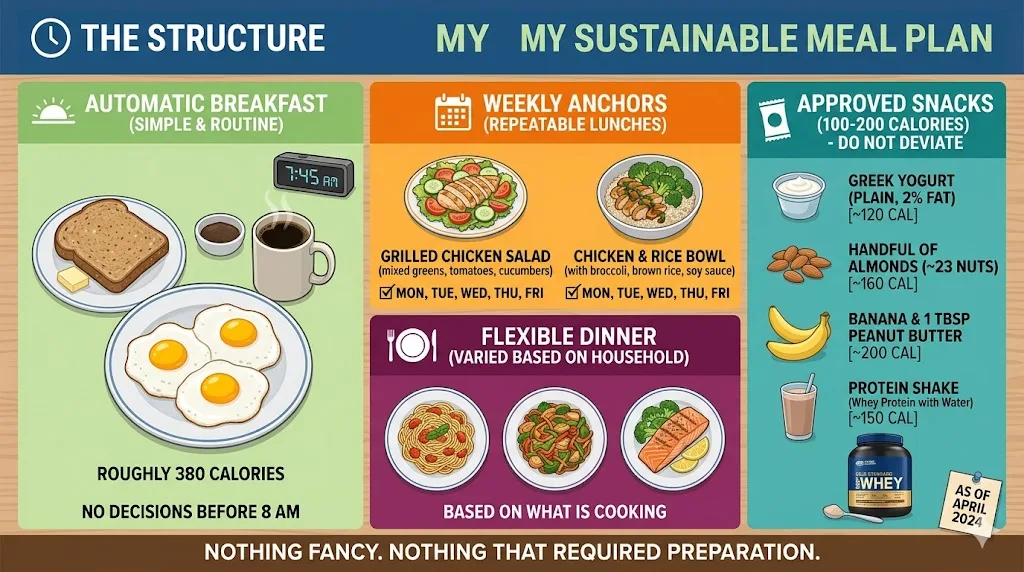
Protein: The Non-Negotiable
Every credible fat-loss researcher agrees on one thing: protein intake matters more than almost anything else when you are trying to lose fat without losing muscle. I targeted 160 grams of protein daily — roughly 0.85 grams per pound of body weight.
To hit that number without spending a fortune on supplements, I leaned on chicken breast, canned tuna, Greek yogurt, cottage cheese, and eggs. These five foods made up probably 70 percent of my protein intake. Boring? Sometimes. Effective? Absolutely.
One honest data point: on weeks when I hit my protein target, I felt far less hungry and retained more muscle definition. On the two weeks I fell under 120 grams due to travel, I noticed more cravings and slightly more fatigue. The data tracked with the research.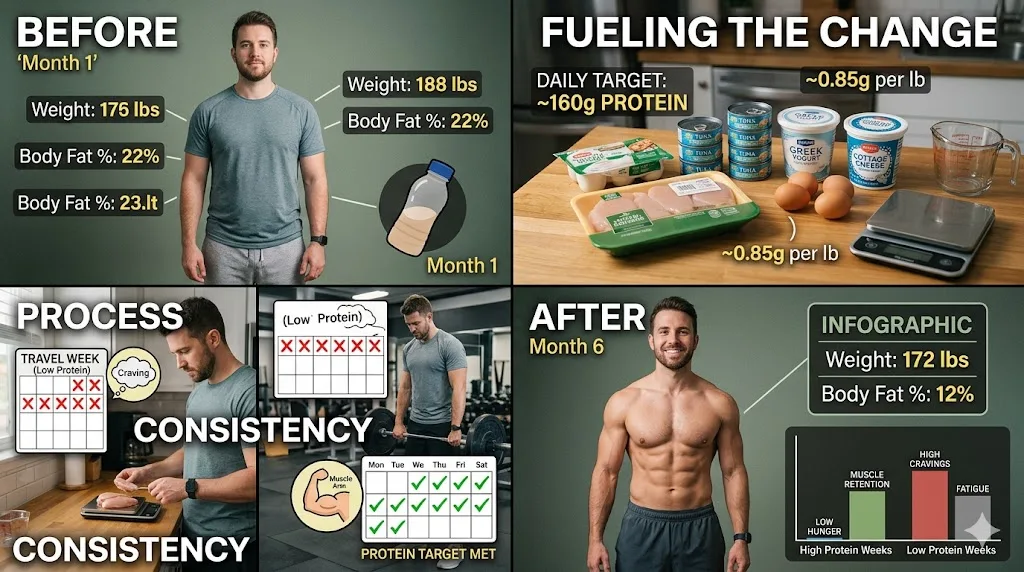
What About Carbs and Fat?
I did not cut carbs dramatically. I reduced refined carbohydrates — white bread, pastries, sugary drinks — and shifted toward complex carbohydrates like oats, sweet potatoes, brown rice, and fruit. Fat intake I kept moderate, roughly 70-80 grams daily, sourced primarily from eggs, olive oil, nuts, and avocado.
I want to be specific here because most articles are vague: I was not doing keto. I was not doing low-fat. I was eating real food in reasonable amounts with a mild calorie deficit. That is it.
My Daily Macro Breakdown (Average Across 11 Weeks)
| Macro | Daily Target | Average Actual | Key Sources |
|---|---|---|---|
| Protein | 160g | 154g | Chicken, eggs, Greek yogurt, whey |
| Carbohydrates | 220g | 208g | Oats, sweet potato, fruit, rice |
| Fat | 75g | 71g | Olive oil, nuts, eggs, avocado |
| Calories | 2,150 | 2,130 | Tracked via Cronometer |
The Exercise Plan: Simple, Consistent, Sustainable
I am going to say something unpopular: you cannot out-exercise a bad diet, and most people waste enormous energy trying. Exercise matters for health, mood, body composition, and long-term weight maintenance. But for direct calorie burn during a fat-loss phase, it plays a supporting role — not the starring one.
That said, exercise was critical to my plan for three reasons. First, it helped me preserve lean muscle while losing fat. Second, it dramatically improved my sleep quality, which made managing hunger far easier. Third, it gave me a psychological anchor — something I could control on days when food decisions felt chaotic.
My Actual Weekly Exercise Schedule
- Monday: Strength training, 45 minutes (upper body focus)
- Tuesday: 30-minute walk, no intensity pressure
- Wednesday: Strength training, 45 minutes (lower body focus)
- Thursday: Rest or light stretching
- Friday: Strength training, 45 minutes (full body)
- Saturday: 45-60 minute hike or longer walk
- Sunday: Complete rest
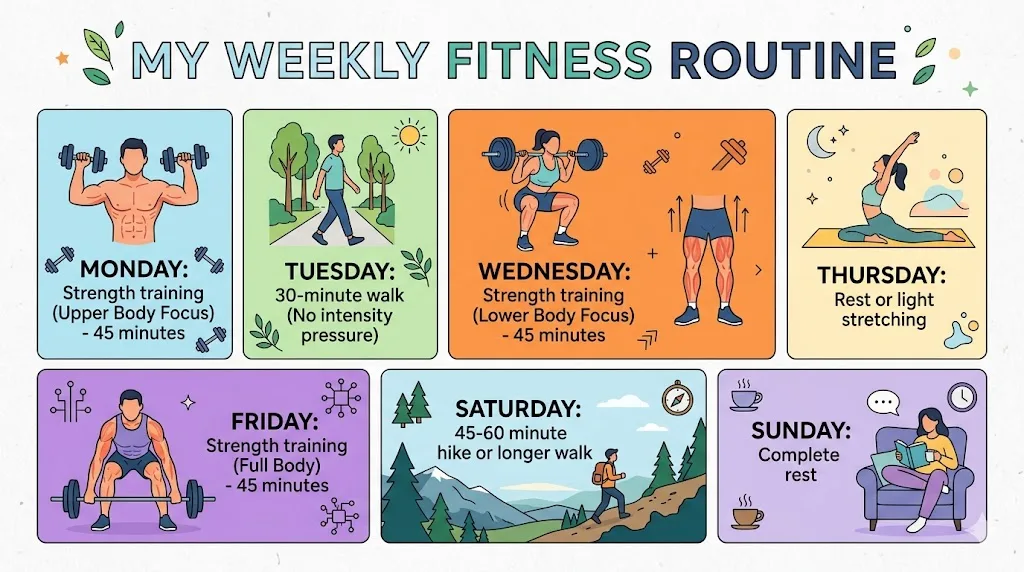
That is three lifting sessions and two walk/hike sessions per week. Nothing elite. Nothing that required a personal trainer or a premium gym membership. I trained at a local gym that cost $24 per month.
The Lifting Program I Used
I followed a modified version of StrongLifts 5×5 for the first six weeks, then transitioned to a push-pull-legs split for the final five weeks. StrongLifts is free, the app is genuinely good, and the programming works for natural lifters at any experience level. My squat went from 175 pounds to 205 pounds during the 11 weeks. I built strength while losing fat. That does not happen when you under-eat protein or over-restrict calories.
Why I Did Not Do Cardio Obsessively
In my 2021 and 2022 attempts, I ran four or five days per week. I was constantly sore, irritable, and hungry. I also lost a significant amount of muscle, which left me looking ‘skinny fat’ rather than lean. Research from the European Journal of Applied Physiology consistently shows that excessive cardio combined with a calorie deficit accelerates muscle loss, particularly without adequate protein. Walking, by contrast, is low-impact, recoverable, and sustainable indefinitely.
Sleep, Stress, and the Invisible Variables Nobody Talks About
Here is something that took me embarrassingly long to understand: sleep deprivation and chronic stress actively sabotage fat loss at a hormonal level. Ghrelin, the hormone that signals hunger, increases when you are sleep-deprived. Leptin, which signals fullness, decreases. Cortisol, the stress hormone, promotes fat storage — particularly around the abdomen. This is not fringe science. This is foundational endocrinology.
During week three of my plan, I hit a rough patch at work. Deadlines, difficult conversations, late nights. My average sleep dropped from 7.2 hours to 5.8 hours for six consecutive days. I gained 0.6 pounds that week despite staying within my calorie target. Not fat gain — water retention from elevated cortisol. But frustrating nonetheless.
The fix was not complicated. I started using a cheap sleep mask (the Alaska Bear brand on Amazon, around $10), cutting off screens 45 minutes before bed, and doing a 10-minute guided meditation using the Insight Timer app (free). Sleep quality improved within three or four days, and the scale moved again by week five.
Managing Stress Without Food
I was a stress eater. Past tense, mostly. My go-to response to a hard day was raiding the pantry after 9 p.m. Recognizing this pattern was the first step. The second step was having a specific alternative behavior ready: a 20-minute walk, a phone call to a friend, or — honestly — just going to bed earlier.
I am not going to pretend I never stress-ate during those 11 weeks. I did, twice. But I logged it honestly in Cronometer, adjusted the next day slightly, and moved on. Perfectionism in a fat-loss plan is often the fastest road to quitting.
The Tools That Actually Helped (And Two That Were a Waste)
People in weight-loss communities love recommending tools. Most of them are unnecessary. Here is my honest assessment of what I used.
Worth It
- Cronometer (free): Far better micronutrient tracking than MyFitnessPal. Used daily.
- Eufy Smart Scale C1 (around $28 on Amazon): Tracks weight and body fat percentage via bioelectrical impedance. Not perfectly accurate for body fat, but directionally useful for trends.
- Optimum Nutrition Gold Standard Whey (~$55 for 5 lbs): Solid protein quality, mixes well, not overly sweet. Chocolate Malt flavor.
- Insight Timer app (free): For sleep meditations. Used the 10-minute ‘body scan’ sessions most nights.
- Apple Health app (free on iPhone): Passive step tracking. My goal was 8,000 steps daily, a target I hit about 70 percent of days.
Not Worth It
- Greens powder supplements: I tried Athletic Greens (now AG1) for two weeks at $79 per month. I felt no measurable difference and found that eating actual vegetables was both cheaper and more satiating.
- Intermittent fasting apps: I experimented with a 16:8 fasting window for three weeks using the Zero app. It did not improve my results and made social situations with food more complicated. I abandoned it without regret.
Weeks 1-3: Adjusted to new habits, scale dropped 3.2 lbs (mostly water and glycogen). Weeks 4-7: Consistent loss of 0.7-1.0 lb/week. Weeks 8-9: Plateau — adjusted sleep, added one extra walk per week. Weeks 10-11: Dropped final 2.1 lbs. Total: 10.4 lbs lost.
The Plateau — What Happened and How I Got Through It
Weeks eight and nine nearly broke my commitment. The scale did not move for 13 consecutive days. After two months of steady progress, stagnation feels like failure. It is not. It is biology.
When you lose weight, your body adapts. Your TDEE decreases because you weigh less and because your body becomes more efficient at the activities you repeat. The 500-calorie deficit you started with gradually closes as you get lighter. This is called metabolic adaptation.
My fix was not dramatic. I dropped my calorie target by 100 calories (from 2,150 to 2,050), added one extra 30-minute walk per week, and increased my daily step goal from 8,000 to 9,500. Within five days, the scale moved again.
The most important thing I did during the plateau? I did not weigh myself every single day and panic. I took a 7-day rolling average of my weight using a simple Google Sheets spreadsheet. Daily fluctuations of one to two pounds are normal due to water, sodium, hormones, and digestion. The trend line, viewed weekly, told the real story.
Frequently Asked Questions
How many calories should I eat to lose weight?
Start by calculating your TDEE using the Mifflin-St Jeor equation. Multiply your BMR by your activity factor. Then subtract 300-500 calories to create a moderate deficit. Avoid dropping below 1,500 calories for men or 1,200 for women without medical supervision — too aggressive a deficit accelerates muscle loss and hormonal disruption.
Can I lose 10 pounds in one month?
Technically possible, but not advisable for most people. Rapid weight loss at that pace typically involves significant water and muscle loss, not primarily fat. A safer, more sustainable target is 0.5 to 1.5 pounds of fat loss per week, which takes 7 to 20 weeks to hit 10 pounds. Slower loss preserves more muscle and is far easier to maintain.
Do I need to go to the gym to lose weight?
No — but resistance training significantly improves body composition outcomes. If a gym is not accessible, bodyweight exercises (push-ups, squats, lunges, rows using a table) combined with regular walking can produce excellent results. The key variable is consistency, not venue.
What if I have a bad day and overeat?
Log it honestly. Do not compensate by starving yourself the next day. A single bad day — even 1,000 calories over target — represents less than a third of a pound of actual fat gain. The damage is almost always psychological, not physiological. Return to your plan the next morning and keep going.
Is intermittent fasting necessary for weight loss?
No. Intermittent fasting is a tool for managing calorie intake, not a metabolic miracle. Research shows no meaningful difference in fat loss between IF and standard calorie restriction when total calories and protein are matched. Some people find IF easier to sustain; many do not. Use whichever eating pattern helps you hit your calorie target most reliably.
What is the fastest way to lose belly fat specifically?
Spot reduction — losing fat from one specific area — is physiologically impossible. You lose fat systemically, and genetics largely determine the order. A sustained calorie deficit, adequate protein, resistance training, and quality sleep will reduce total body fat including abdominal fat over time. There is no shortcut.
What I Would Tell My March 4th Self
Eleven weeks after I stepped on that scale at 187 pounds, I weighed 176.6 pounds. I had more energy than I had felt in two years. My sleep was better. My strength was up. And most importantly, I was not exhausted by the effort — because I had built something I could actually sustain.
The plan was not glamorous. No transformation shakes, no celebrity trainer, no 75 Hard challenges. Just a mild calorie deficit, consistent protein intake, three lifting sessions per week, long walks, better sleep, and honest tracking.
The one thing I wish I had understood sooner: the plan that works is not the most aggressive one. It is the most consistent one. Losing 10 pounds in 11 weeks while building strength and sleeping better is not a dramatic story. It is a boring one. And boring, in this context, is exactly right.
If you are starting today, do these three things first: calculate your TDEE, set a protein target of 0.7-1g per pound of body weight, and take one 30-minute walk. That is your entire week one plan. Build from there.
What does your biggest obstacle look like right now — time, knowledge, motivation, or something else entirely? Share it in the comments. I read every one.
Published: April 2024 | Updated: April 2026 | Reading time: approx. 12 minutes