
FREE TOOL
Table of Contents
ToggleRecipe Cost Calculator
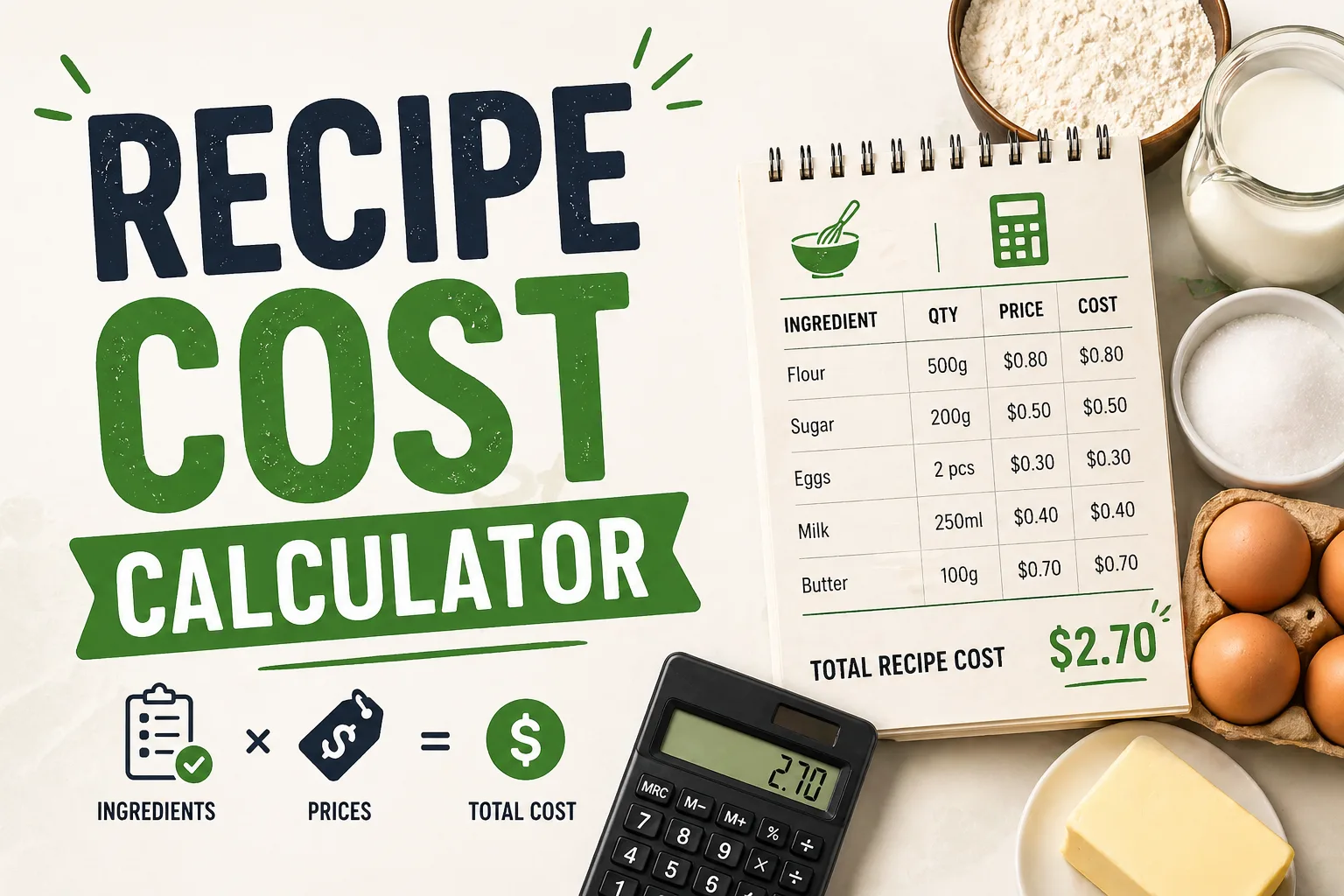
Calculate your true recipe costs — ingredients, labor & overhead — then set the perfect selling price to maximize profit.
🍰
📋 Recipe Details Step 1
Try an example:
🧈 Ingredients Step 2
💡
How it works: Enter how much your recipe uses, the full package size you buy, and the package price. The calculator finds the exact cost for just the portion you used.
Example: Recipe uses 300g flour — Package is 1kg at $2.50 → Flour cost = $0.75
Example: Recipe uses 300g flour — Package is 1kg at $2.50 → Flour cost = $0.75
IngredientRecipe QtyUnitPkg SizePkg PriceCost
No ingredients yet — add one below!
⏱️ Labor Cost Step 3
💡
Don't work for free! Include all your time — prep, baking, decorating, cleanup. Home bakers typically charge $15–$30/hr. This is often the biggest hidden cost.
×
=
$40.00
📦 Overhead & Packaging Step 4
💡
What is overhead? Electricity, gas, packaging (boxes, bags, labels), parchment paper, cupcake liners — all the costs beyond ingredients. Typically $1–$5 flat, or 10–15% of ingredient cost.
Flat $1–$5 per batch is typical for home bakers.
📊 Your Results Step 5
Total Cost
$0.00
Full batch
Cost / Serving
$0.00
Break-even point
Sell At
$0.00
Recommended price
Profit / Serving
$0.00
Your earnings
Profit Margin
60%
10% (low)100% (standard)200% (premium)
A 50–100% margin is standard for home bakers and small bakeries.
Cost Breakdown
Ingredients
$0.00 (0%)
Labor
$0.00 (0%)
Overhead
$0.00 (0%)
Total
$0.00
📚 Understanding Recipe Costs
Whether you're a home baker or running a small bakery, knowing your true cost is the foundation of a profitable business. Most people only count ingredients — and end up working for free. Here's the complete picture:
Total Recipe Cost = Ingredients + Labor + Overhead
Selling Price per Serving = (Total Cost ÷ Servings) × (1 + Margin %)
🎓 6 Key Concepts
🧈
Ingredient Cost
For each ingredient: (Recipe amount ÷ Package size) × Package price. You only pay for what you use — not the whole package.
⏱️
Labor Cost
Your time has value! Hours × hourly rate. Include prep, baking, decorating, and cleanup. $15–$30/hr is common for home bakers.
📦
Overhead
Hidden costs like electricity, gas, boxes, bags, and labels. Use a flat $1–$5 per batch or 10–15% of ingredient cost.
💰
Profit Margin
How much profit you want on top of your cost. A 60% margin means if cost is $5, you sell for $8. Standard for baked goods: 50–100%.
🍽️
Cost Per Serving
Total cost divided by servings. If 24 cookies cost $18 to make, each cookie costs $0.75 — that's your break-even point.
📈
Food Cost %
Ingredients ÷ Selling price. Ideally 25–40% for bakeries. If yours is higher, find cheaper suppliers or adjust your price.
📐 Unit Conversions Reference
Weight
1 kg = 1,000 g
1 lb = 453 g
1 oz = 28 g
1 stick butter = 113 g
Volume
1 L = 1,000 ml
1 cup = 240 ml
1 tbsp = 15 ml
1 tsp = 5 ml
Common Baking
1 cup flour ≈ 120 g
1 cup sugar ≈ 200 g
1 cup butter ≈ 227 g
1 large egg ≈ 50 g
Pricing Tips
Decorated items: 65–100% margin
Plain breads: 40–60% margin
Specialty: 80–120% margin
Wholesale: 30–50% margin
❓ Frequently Asked Questions
How do I calculate the cost of a recipe?
▾
For each ingredient, divide the package price by the package size to get the cost per unit, then multiply by the amount your recipe uses. Add up all ingredient costs, then add labor (hours × hourly rate) and overhead (packaging, electricity — typically $1–$5/batch or 10–15% of ingredient cost). Divide the total by servings to get your cost per serving — that's your break-even point.
How much should I charge for baked goods?
▾
Use this formula: Selling Price = Cost per Serving × (1 + Margin%). For home bakers, a 50–100% margin is standard. If a dozen cookies costs $8 to make, charge $12–$16. Decorated cakes and macarons with high skill requirements can command 80–120% margins. Always research what competitors in your area charge.
Should I really include my labor cost?
▾
Absolutely — this is the #1 mistake home bakers make. If you skip labor, you're essentially volunteering your time. Even charging minimum wage makes a huge difference to your pricing. Your skills have value, especially for complex items like wedding cakes or detailed sugar cookies. Start at $15/hr and increase as your skills grow.
What overhead costs should I include?
▾
Overhead includes: packaging (boxes, bags, labels, ribbon), utilities (electricity, gas, water), supplies (parchment paper, cupcake liners, piping bags, disposable gloves), equipment wear and tear, and business costs (insurance, permits, website). For home bakers: $1–$5 flat per batch is a simple approach. Alternatively, use 10–15% of your ingredient cost.
What is a good food cost percentage for a bakery?
▾
Industry standard: ingredient cost should be 25–40% of the selling price. If you sell a cake for $40, ingredients should ideally cost $10–$16. Labor and overhead add another 20–35%, leaving 25–55% as gross profit. Home bakers have lower overhead, so their food cost % can be slightly higher while still making good money.
My costs seem too high — how do I reduce them?
▾
First, identify your most expensive ingredients in the cost breakdown. Then: (1) Buy in bulk — larger packages are cheaper per unit. (2) Shop wholesale suppliers or restaurant supply stores. (3) Compare brands for commodity ingredients like flour and sugar. (4) Reduce batch waste by measuring precisely. (5) If labor is high, practice to get faster at decorating. Sometimes raising your price is the right answer!
How do I embed this calculator on WordPress?
▾
Save this file and upload it to your server. Then use an HTML iframe block in WordPress: add a Custom HTML block and paste <iframe src="URL-to-file" width="100%" height="1200" frameborder="0"></iframe>. Alternatively, use a plugin like "WP File Manager" to host the file, or embed using the "Iframe" block in Gutenberg. For best results, host the file in your theme's /files/ directory.
Want to know your body health? Try our BMI Calculator now.