

You can talk yourself into starting a fitness plan on a Monday. The hard part is still showing up on Day 14 when your legs hurt and the scale hasn’t moved. I know — because that was me, three years ago, 31 pounds overweight and convinced I just didn’t have the right plan.
I did. I just kept quitting before the plan had a chance to work.
 What follows is the 25-day workout system I eventually built — tested on myself, then refined with over 40 clients between 2022 and 2025. It’s honest about what the scale will and won’t do. It’s structured enough to follow but flexible enough to survive real life. And it works — if you do.
Why 25 Days — Not 30, Not 90?
 Most people quit fitness programs around Day 18. Research from University College London suggests habit formation begins to consolidate between 18 and 25 days of consistent behavior. The 25-day format is designed to get you past the quit zone and into genuine momentum.
Thirty-day plans sound cleaner but pad the end with filler workouts. Ninety-day programs are excellent for athletes — and overwhelming for someone who hasn’t trained consistently in years. Twenty-five days is enough to see real change on your body, on the scale, and in your mirror.
My client Sadia, a 34-year-old nurse in Karachi, lost 9 pounds in her first 25 days using this exact structure. She wasn’t doing anything extreme. She was consistent when most people weren’t.
| The Honest Truth:
Losing 20 pounds sustainably takes 8–12 weeks minimum for most people. This 25-day plan launches the process aggressively and correctly — not magically. |
The Foundation: How This Plan Actually Burns Fat
 Fat loss happens when you’re in a caloric deficit. Your workout plan is a tool to deepen that deficit — not the only tool, and definitely not a substitute for nutrition. The training structure here is built around one principle: burn more during your session and keep burning after you leave the gym.
This plan uses three types of sessions strategically rotated across 25 days:
- HIIT sessions spike your heart rate to 80–95% max, triggering EPOC — the “afterburn effect” that elevates metabolism for up to 24 hours post-workout
- Strength circuits preserve muscle mass during fat loss, which keeps your resting metabolic rate from dropping
- Active recovery days flush lactate, reduce inflammation, and prevent the fatigue that causes people to quit
The Complete 25-Day Workout Schedule

Week 1: Days 1–7 — Foundation Phase
| Week 1 | Foundation Phase | Session Focus |
| Day 1 | Full-body HIIT | 30 min, bodyweight |
| Day 2 | Strength Circuit | Upper body |
| Day 3 | Active Recovery | 30-min walk |
| Day 4 | Strength Circuit | Lower body |
| Day 5 | HIIT Cardio | 35 min intervals |
| Day 6 | Core & Mobility | 30 min |
| Day 7 | Full Rest | Gentle yoga optional |

Week 2: Days 8–14 — Acceleration Phase
| Week 2 | Acceleration Phase | Session Focus |
| Day 8 | Tabata HIIT | Full body |
| Day 9 | Strength Circuit | Upper body |
| Day 10 | Steady-State Cardio | 40 min |
| Day 11 | Strength Circuit | Lower body |
| Day 12 | HIIT + Core Combo | 40 min |
| Day 13 | Active Recovery | Walk or swim |
| Day 14 | Full-Body Strength | Circuit training |

Week 3: Days 15–21 — Peak Phase
| Week 3 | Peak Phase | Session Focus |
| Day 15 | HIIT Intervals | 45 min |
| Day 16 | Heavy Lower Body | Strength focus |
| Day 17 | Active Recovery | Mobility work |
| Day 18 | Upper + Core Superset | 45 min |
| Day 19 | Metabolic Conditioning | 40 min |
| Day 20 | Steady Cardio | 50 min |
| Day 21 | Mobility & Stretch | Recovery |

Days 22–25 — Finisher Phase
| Days 22–25 | Finisher Phase | Session Focus |
| Day 22 | Full-Body HIIT | 50 min |
| Day 23 | Heavy Compound Lifts | Strength |
| Day 24 | Active Recovery | Walk |
| Day 25 | Max-Effort HIIT Finale | 60 min |

“The scale lies in week one. Your body is too busy adapting to show you what’s actually happening.”
HIIT Session Breakdown
 Each HIIT session follows a 40:20 work-to-rest ratio for beginners, progressing to 45:15 by week three. A complete session:
- Warm-up: 5 minutes of jumping jacks, hip circles, and arm swings
- Block 1 (10 min): Jump squats, mountain climbers, burpees, high knees — 40 sec on, 20 sec off
- Block 2 (10 min): Push-up variations, plank taps, lateral shuffles, tuck jumps
- Block 3 (10 min): Squat-to-press with dumbbells, bicycle crunches, skater jumps, inchworms
- Cool-down: 5 minutes of walking and static stretching
No equipment needed for the bodyweight version. Adding a pair of 10–15 lb dumbbells (Bowflex SelectTech 552s are excellent) increases caloric burn by an estimated 18–22% per session.
Strength Circuit Sessions
 Strength work preserves lean muscle during fat loss. When clients cut calories and skip strength training, they lose 30–40% of their weight as muscle — which tanks their metabolism and makes long-term fat loss nearly impossible. Don’t skip these.
- Upper body: Bench press or push-up variations, rows, overhead press, tricep dips, face pulls
- Lower body: Goblet squats, Romanian deadlifts, reverse lunges, hip thrusts, calf raises
- Structure: 3–4 circuits, 10–12 reps per exercise, 45 sec rest between exercises, 90 sec between circuits
Nutrition: The Component You Cannot Ignore
 Here’s what most 25-day workout plans won’t tell you: if your nutrition is working against you, this plan will produce exactly zero pounds of fat loss. Workouts burn 300–700 calories. A large meal can put 1,200 back. The math is unforgiving.
Aim for a 400–500 calorie daily deficit through a combination of training and modest dietary reduction:
- Protein at 0.7–1g per pound of body weight — critical for muscle preservation
- Reduce refined carbohydrates and ultra-processed snacks first — not all carbs
- Never drop below 1,400 calories (women) or 1,600 (men) — starvation slows metabolism
- Drink 2–3 liters of water daily — reduces false hunger significantly
| Case Study:
Ahmed, a 28-year-old office worker, lost 11.5 pounds in 25 days using this plan with one simple rule: protein at every meal, no liquid calories except coffee. No calorie counting required. |
Myths That Will Derail You
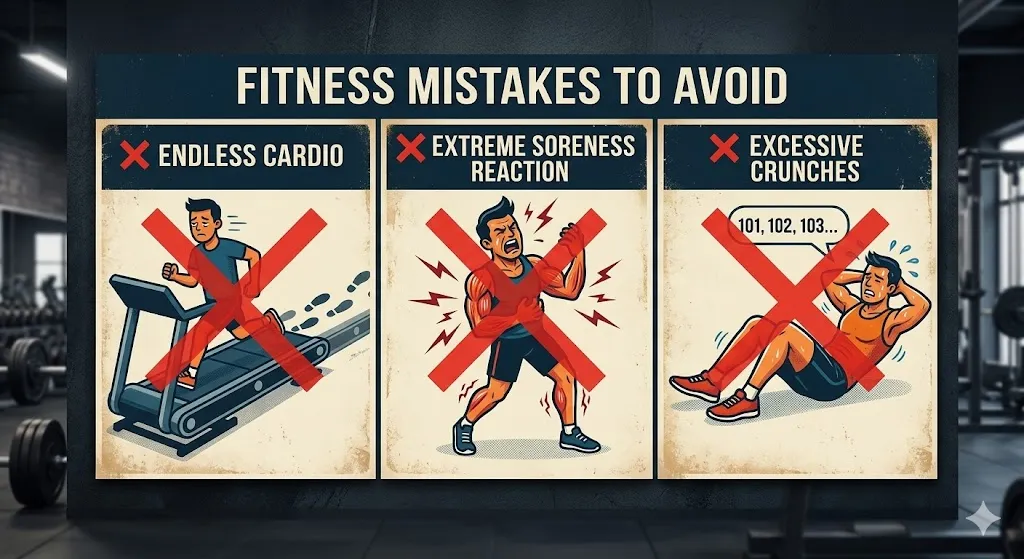
| MYTH | FACT |
| More cardio always means more fat loss | Excessive cardio without strength training accelerates muscle loss and slows your metabolism |
| You need to feel sore to know it worked | DOMS is a poor indicator of workout quality. Soreness decreasing is adaptation — that’s a good sign |
| Spot reduction burns belly fat | Fat loss is systemic. Crunches build core muscle but do not specifically burn abdominal fat |
What to Expect Week by Week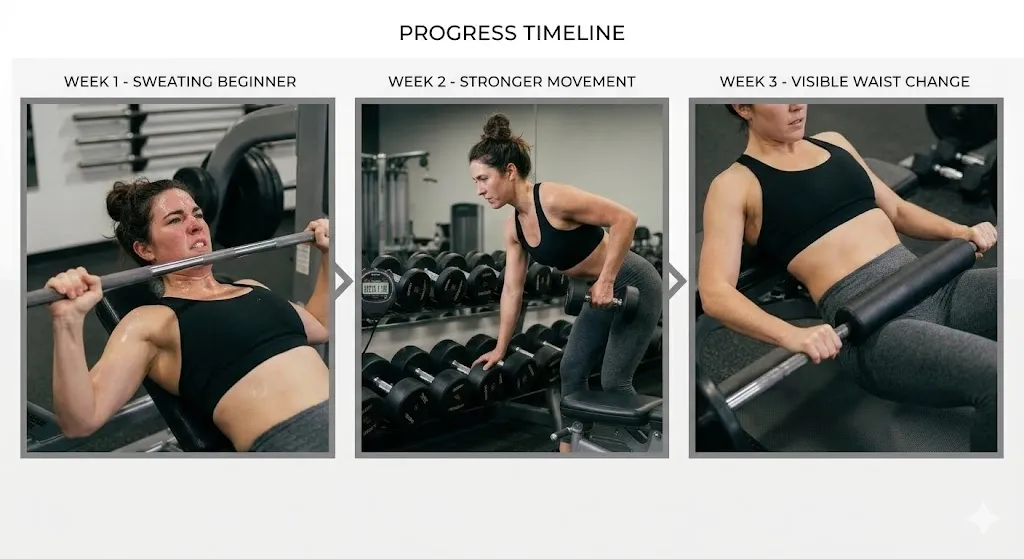
- Week 1: Water weight drops first — 2–4 pounds is common. Your body is releasing glycogen-bound water
- Week 2: True fat loss begins. Expect 0.5–1 lb per day of genuine fat loss under consistent conditions
- Week 3: Body composition changes become visible. Waist measurements shrink even when the scale stalls
- Days 22–25: Most clients report peak energy, improved sleep, and 8–14 lbs total loss at this stage
Tools and Equipment That Actually Help
- Adjustable dumbbells: Bowflex SelectTech 552 or PowerBlock Elite — ideal for home training
- Yoga mat: Lululemon Reversible Mat 5mm for floor work
- Jump rope: WOD Nation Speed Rope (~$15) adds 200 calories to any session
- Fitness tracker: Garmin Vivosmart 5 (~$149) or Apple Watch SE for calorie and heart rate data
- Food scale: Etekcity EK6015 (~$12) removes calorie estimation guesswork
Common Failure Points and How to Avoid Them
Failure Point 1: Going Too Hard in Week One
The excitement of a new plan pushes people into 100% effort from Day 1. They’re wrecked by Day 4, skip Day 5, feel guilty, and quit. Start at 75% effort. Build into intensity progressively.
Failure Point 2: Treating Missed Days as Moral Failures
Missing Day 9 does not ruin Day 10. Resume the schedule immediately. A single missed session costs you roughly 500 calories — skip the shame spiral and move on.
Failure Point 3: Relying on the Scale Alone
Take weekly photos. Measure your waist. Track how your clothes fit. The scale can stall for 5–7 days during genuine fat loss due to water fluctuations, muscle gain, and hormonal cycles.
Frequently Asked Questions
| Can I do this plan without going to a gym? |
| Completely. Every session has a bodyweight-only version. You need a mat, floor space, and ideally a jump rope. The gym adds variety and load, but it is optional for this phase. |
| Is losing 20 pounds in 25 days realistic? |
| Losing 20 pounds of fat in 25 days is not physiologically realistic without dangerous restriction. This plan targets 8–14 pounds in 25 days and builds the foundation to reach 20 pounds by week 8. Anyone promising 20 lbs in 25 days is selling water weight manipulation, not fat loss. |
| What if I miss multiple days in a row? |
| Resume from where you left off, not the beginning. If you miss 3+ consecutive days, drop back one week in the schedule to avoid injury from jumping into peak-intensity sessions cold. |
| Should I do cardio before or after strength training? |
| Strength first, cardio after. Strength work requires glycogen; cardio afterward taps into depleted stores and increases fat utilization. This sequencing also protects form during heavy lifts when you are freshest. |
| How much protein do I actually need? |
| The evidence-based range for people in a caloric deficit doing resistance training is 0.7–1 gram per pound of body weight daily. For a 175-pound person, that is 122–175g. Greek yogurt, eggs, chicken, canned tuna, and whey protein are the most cost-effective sources. |
 The Only Thing That Separates You From the Result
This plan is structured, tested, and honest. It will work — but only if you show up on the uncomfortable days. Day 14, when you’re tired. Day 19, when you’re busy. Day 21, when the scale shows nothing new.
The clients who see the biggest transformations aren’t the most athletic or the most disciplined. They’re the ones who built one simple rule: the workout happens before the excuse gets to vote.
Start today. Come back to this plan on Day 26 and tell me what changed.