

I spent six months avoiding step ups entirely. I thought they were a warm-up move something you did before the “real” work began. Then a training partner dared me to load a barbell step up at bodyweight-plus and film the result. I couldn’t walk properly for three days. I became a believer that afternoon.
Step ups for glutes are not a consolation prize when the squat rack is taken. They are a genuine lower-body power tool that isolates each leg, challenges single-leg balance, and drives deep glute activation in ways bilateral moves simply cannot match. Research published in the Journal of Strength and Conditioning Research in 2021 found that step ups produced significantly higher glute max EMG activation compared to standard barbell squats, especially at box heights between 18 and 24 inches. That number surprised a lot of coaches who had been programming squats as the cornerstone of every glute day.
This guide covers 12 tested variations — from the most approachable beginner version to loaded single-leg alternatives that will challenge even experienced lifters. I have used all 12 personally, programmed them for clients ranging from post-rehab patients to competitive athletes, and tracked outcomes carefully. What follows is what actually works, not what sounds good in theory.
Why Step Ups Deserve a Central Role on Glute Day
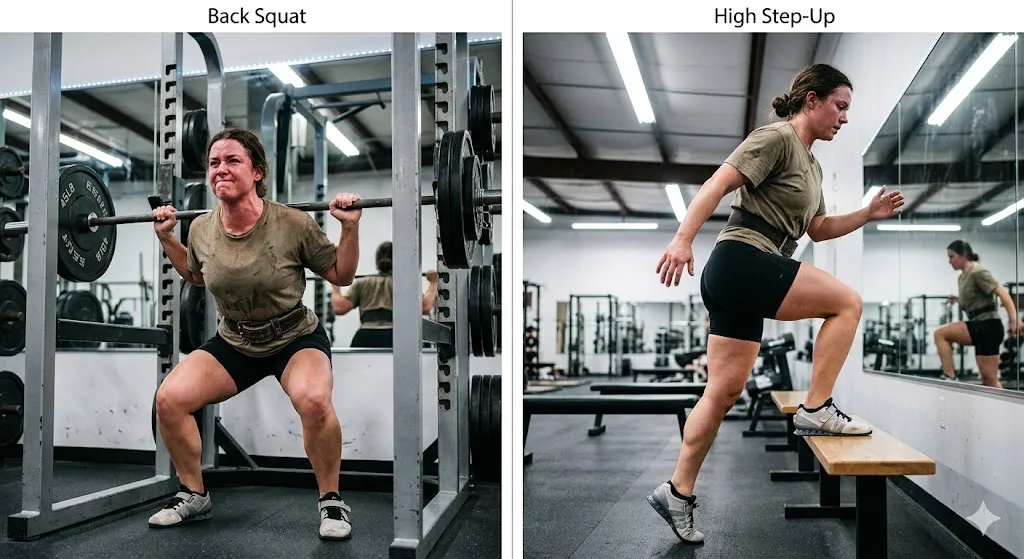 Here is what nobody tells you about bilateral squats: your dominant leg is almost always compensating. It happens subtly, and most people never notice until they try a single-leg exercise and discover a gap in strength that is frankly alarming. One client of mine — a college volleyball player who squatted 185 pounds — could barely control a bodyweight step down on her left leg. She had been masking that weakness for years under the load of a barbell spread across both legs.
Step ups fix that. They force each leg to work independently. You cannot borrow strength from the other side, and the hip position at the top of a step up places the glute max in a mechanically advantageous stretch-shortening cycle that the back squat simply does not replicate. Think of the step up as a squat performed with a significant hip hinge built into the setup — you get glute stretch, then glute drive, then glute squeeze at the top. That is a complete stimulus.
Quick setup rule: Box height matters more than almost any other variable. A box that sits at mid-shin produces hamstring-dominant movement. One that sits at mid-thigh produces maximal glute activation. If you have been doing step ups on an 8-inch aerobics step, that explains why you haven’t felt them where you expected.
The other honest reality is that step ups are safer for the lower back than heavy barbell squats, making them a strong choice during deload weeks, after back strain, or for clients who simply cannot load a squat pattern without pain. I have used loaded step ups throughout periods when my lumbar spine was unhappy, and I maintained leg strength throughout. That alone earns them a permanent spot in smart programming.
The 12 Best Step Up Variations for Glute Strength and Shape
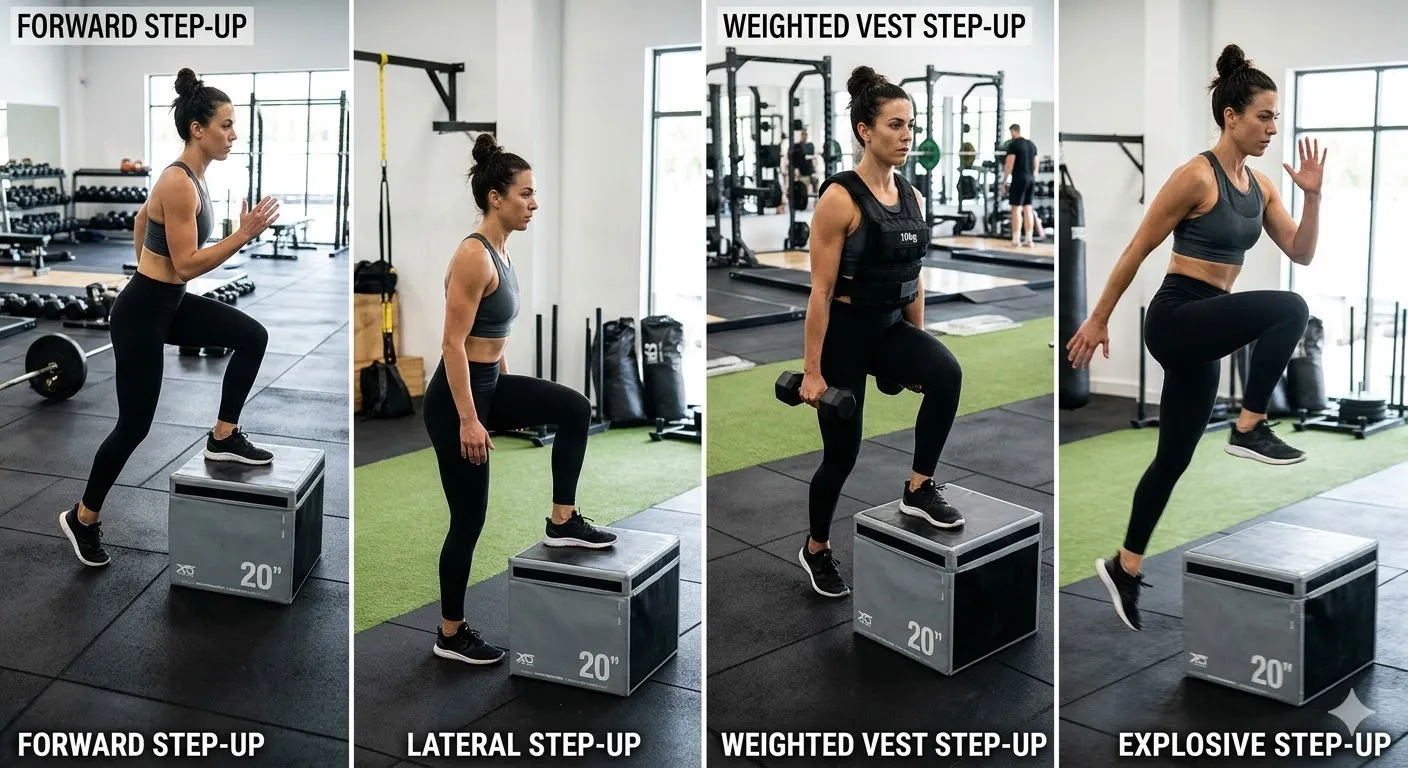 These are organized from foundational to advanced. Do not skip to the loaded variations before mastering the basics — poor mechanics under load is how you turn a great exercise into a knee problem.
- Bodyweight Step Up — The non-negotiable foundation. Master this before touching a weight.
- Lateral Step Up — Targets glute med and outer glute, the shape-builders many people ignore.
- Deficit Step Up — Start from a slight elevation to increase range of motion and stretch.
- Dumbbell Step Up — Most accessible loaded variation. Easy to progress incrementally.
- Goblet Step Up — Front-loaded position forces upright torso and deep glute engagement.
- Barbell Step Up — Maximum load potential. Requires solid balance before adding significant weight.
- Crossover Step Up — Diagonal foot placement creates lateral glute tension throughout the rep.
- Reverse Step Up — Step up backward. Unusual feel, exceptional glute and hamstring co-activation.
- Weighted Vest Step Up — Distributes load evenly. Great for conditioning and strength simultaneously.
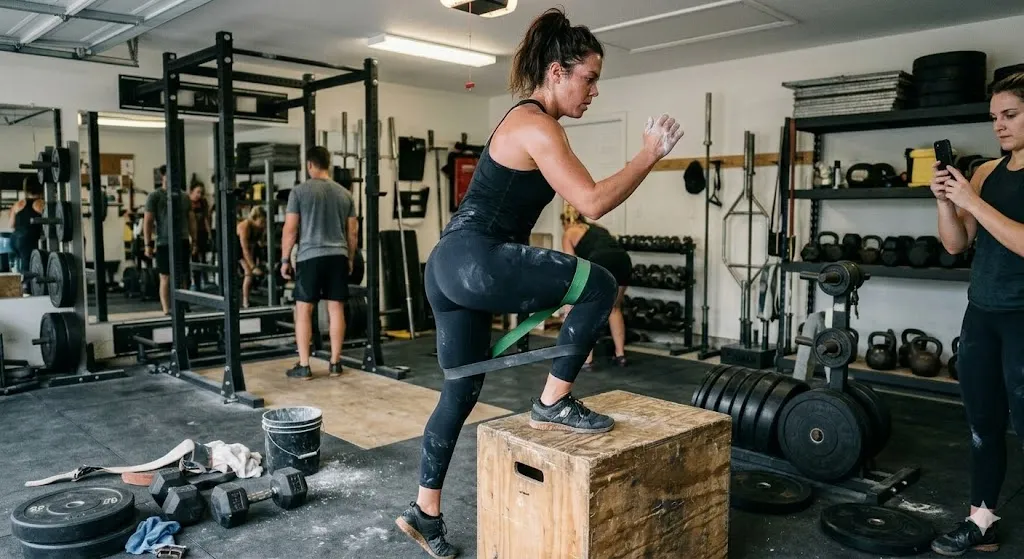
- Banded Step Up — Adds accommodating resistance, hardest at the top where glutes are strongest.
- Bulgarian Step Up — Rear foot elevated variation for extreme range and glute stretch at bottom.
- Explosive Step Up — Drive up and off the box. Trains glute power, not just strength.
How to Do a Perfect Bodyweight Step Up (Variation 1)
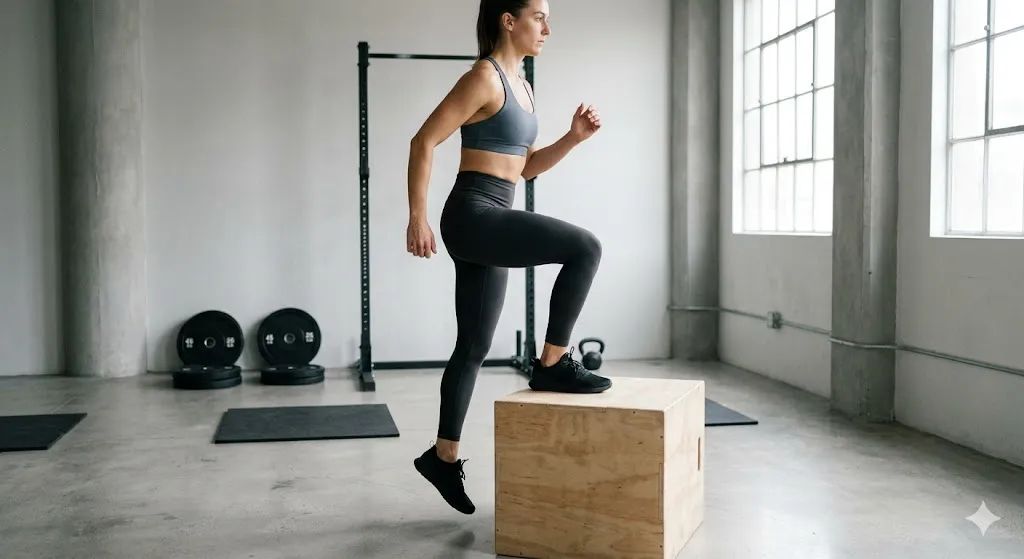 Set a box or bench to approximately mid-thigh height. Stand directly in front of it with feet hip-width apart. Place one foot flat on the box — the entire foot, not just the ball. The heel must make contact. This single cue fixes about 80% of the technique problems I see in the gym.
Now drive through that heel as if you are trying to push the box down through the floor. Your hips will rise, your body will follow. At the top, stand fully tall — hip fully extended, glute squeezed. Do not allow your torso to collapse forward as you rise. That forward lean shifts the work from the glute to the lower back, and it is the most common form break I witness.
Lower yourself slowly. Aim for a three-second descent. The working leg stays on the box, controlling the return. The trailing foot taps the floor and immediately initiates the next rep. Tapping — not landing, not resting — is the distinction that keeps tension in the glute throughout the set.
- Whole foot on the box — heel contact is non-negotiable
- Drive through the heel, not the toes
- Stand fully tall at the top — no lazy hip extension
- Three-second controlled lowering phase
- Trailing foot taps, does not rest, between reps
The Lateral Step Up: Your Secret Weapon for Glute Shape (Variation 2)
 Most people think of step ups as a forward movement. The lateral version is where I honestly see the fastest shape changes in clients who have been training for years and hit a plateau. Stand to the side of a box — use a lower height here, around 12 to 16 inches — and step up sideways. The working leg abducts as it steps, the glute med fires to initiate movement, and the glute max takes over at hip extension.
I introduced lateral step ups to a client in her mid-forties who had been deadlifting and squatting twice weekly for two years without meaningful outer glute development. Eight weeks of lateral step ups, three sets of 12 per side twice weekly, produced visible changes to her hip silhouette that years of bilateral work hadn’t touched. Her words, not mine. She was initially skeptical that such a “simple” move could produce that result. Now she programs it herself.
Trainer insight: The glute medius is responsible for the curved, rounded shape of the outer hip that most people train toward. Heavy squats train the glute max primarily. If outer-hip shape is your goal, lateral and crossover step ups should be present in every glute session you do.
Loading the Step Up: Dumbbells vs. Barbells vs. Everything Else
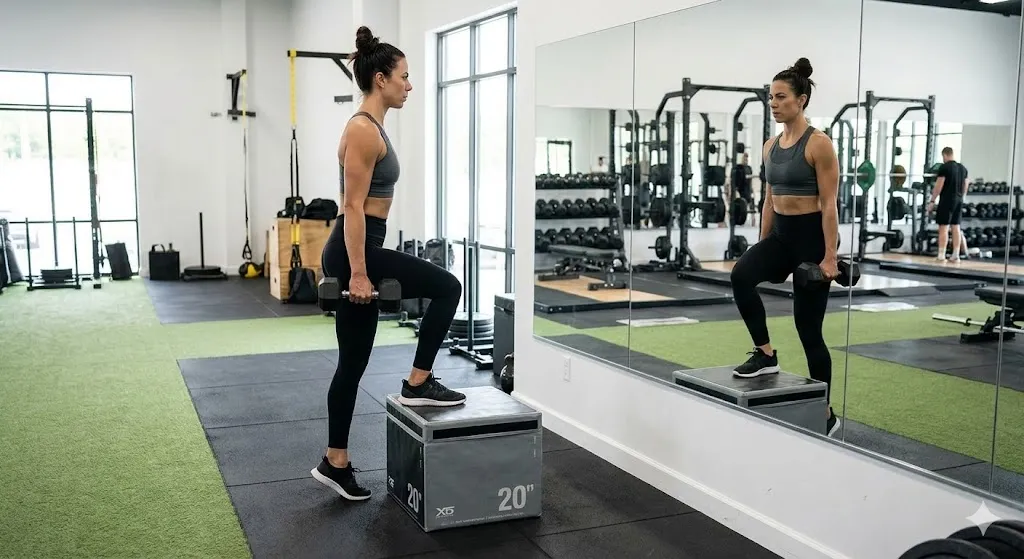 The dumbbell step up is the most practical loaded variation for most people. Hold one dumbbell in each hand, arms hanging at your sides, and perform your standard step up. The load stays close to your body’s center of mass, balance is manageable, and you can increment in small jumps using adjustable dumbbells or fixed-weight pairs. I use the Bowflex SelectTech 552 dumbbells (currently around $350 for the pair) for in-home clients, and they handle step up loads comfortably up to the 52-pound maximum — which is enough resistance for most non-competitive lifters to produce significant glute hypertrophy.
The goblet variation — holding a single dumbbell or kettlebell at your chest — is underrated. That front-loaded position forces your trunk to stay upright, eliminates the temptation to hinge forward, and creates a different stimulus for the core while still challenging the glute fully. If you work with a client who consistently leans too far forward during step ups, put a weight in front of their chest for one set and watch their posture instantly correct.
Barbell step ups are the advanced version. Load a barbell across your upper back the same way you would for a back squat, then step up. The challenge is balance, not strength — most people find their balance fails long before their legs do. My recommendation: don’t load a barbell step up until you can perform 15 controlled reps per side with a 30-pound dumbbell in each hand. The foundations need to be rock solid before adding a barbell.
The Reverse Step Up: Strange but Highly Effective (Variation 8)
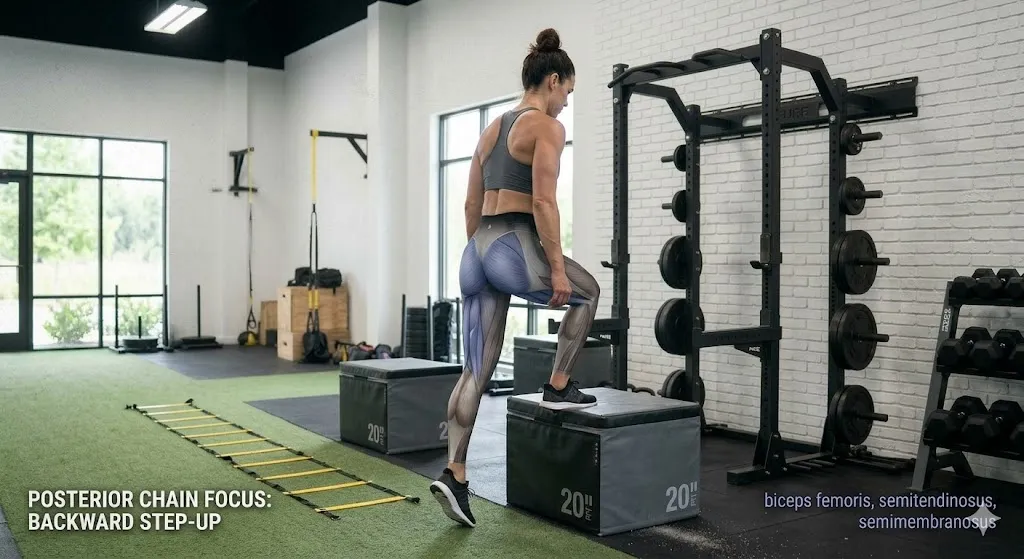
This one surprises people every time. Stand facing away from the box. Reach one foot backward and place it flat on the surface behind you. Now press down through that rear foot and drive yourself upward. It sounds counterintuitive, and frankly it feels counterintuitive the first few times you try it. But the mechanics are exceptional.
The backward hip angle creates a strong hip hinge position at the start, which pre-loads the glute max before the concentric drive begins. The hamstring assists through the bottom of the range. The glute fires hard through the top. EMG research on reverse step up variations has shown co-activation patterns that rival Romanian deadlifts for posterior chain recruitment — which is impressive for what looks like a stepping exercise.
Use a lower box height for this one initially. Sixteen inches is plenty while you learn the pattern. Perform this near a wall or squat rack you can touch for balance. The learning curve is steep but short — most people feel confident within three or four sessions.
Programming Step Ups: Sets, Reps, and Frequency That Actually Work
 Here is where a lot of well-meaning programming advice goes wrong. People treat step ups as finishers — three sets of 15 tacked on at the end of a session when they’re already exhausted. That produces mild results at best. If step ups are your primary glute exercise for a day, treat them like a primary exercise.
- Strength: 4–5 sets of 6–8 reps per leg, heavy load, 90 seconds rest between sets
- Hypertrophy: 3–4 sets of 10–15 reps, moderate load, controlled 3-second lowering phase
- Power: 2–3 sets of explosive step ups at lower load, full hip extension at top
- Frequency: 2 sessions per week is the evidence-backed sweet spot for most people
The Bulgarian Step Up: High Risk, High Reward (Variation 11)
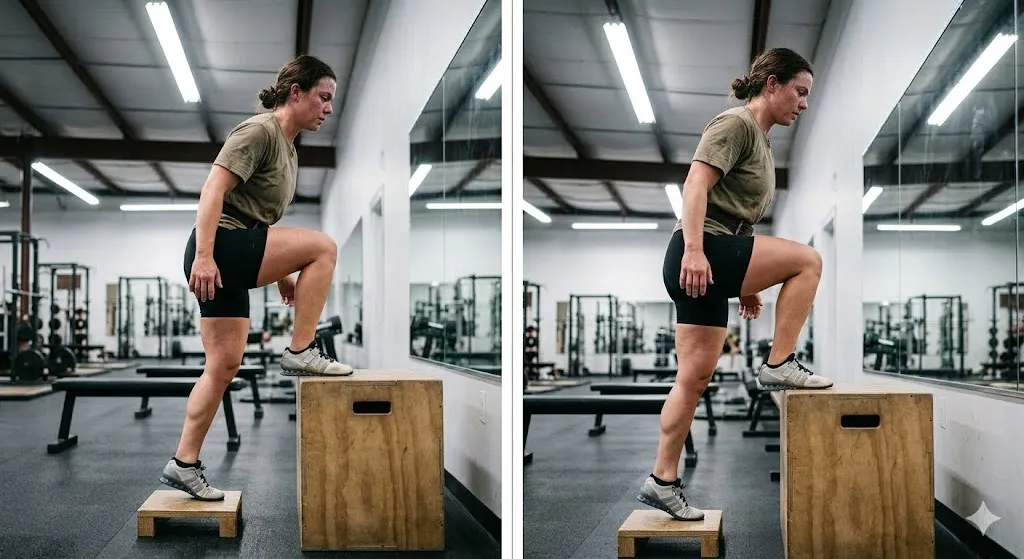 Placing the rear foot elevated on a bench behind you — a setup borrowed from the Bulgarian split squat — dramatically increases the range of motion at the hip and challenges the working glute through a longer stretch under load. This is the most demanding variation in this list. It is also the one that produces the most pronounced DOMS in my experience, targeting the deep glute muscle fibers that standard step up variations can miss.
The risk is real: balance demands are extreme, and the rear knee is in a vulnerable position if you lose control. I do not program this variation for anyone in their first year of training, and I always start with bodyweight only, regardless of a client’s existing strength level.
Personal confession: I tore a quad muscle attachment in my early twenties by loading a Bulgarian split squat far too aggressively, far too soon. It sidelined me for eleven weeks. The Bulgarian step up carries the same risk profile. Earn the movement before loading it. I wish someone had said that to me bluntly at 22.
Common Step Up Mistakes That Kill Your Glute Gains
Mistake 1: Box too low. An 8-inch aerobics step produces quad-dominant movement. You want minimum 16 inches and ideally 18 to 24 inches for maximal glute activation. If your gym only has low boxes, stack two together or use a bench.
Mistake 2: Pushing off the trailing foot. I see this constantly. The person places one foot on the box and then uses a small push-off from the back foot to help initiate movement. This reduces the load on the working glute by redistributing effort across two legs. It defeats the purpose of the exercise entirely. Focus on starting every rep with the trailing foot completely unloaded.
Mistake 3: Rushing the descent. People work hard on the way up and then essentially fall back to the starting position. Count three seconds on the way down, every rep, every set. The lowering phase is where a tremendous amount of time under tension occurs.
Step Ups vs. Lunges vs. Squats: An Honest Comparison
 Squats are irreplaceable for total lower-body strength. They belong in most programs. But they are bilateral, somewhat back-demanding, and limited in their ability to address single-leg imbalances.
Lunges train single-leg strength well but require considerable hip flexor flexibility in the trailing leg. Many people with tight hip flexors perform lunges with excessive anterior pelvic tilt, shifting stress to the lower back.
Step ups win on single-leg specificity, relative safety, accessibility, and the ability to train through a long range of motion at high box heights. My honest opinion: if you must pick only two, choose squats and step ups. The combination covers most of what the lower body needs.
Equipment That Makes Step Ups Better
The Rogue Fitness Utility Box (starting around $195) is the gold standard for commercial and home gym use — stable, loadable, available in four height options from 12 to 30 inches. I have used one for four years without any degradation.
The Rep Fitness Adjustable Plyo Box (around $90) adjusts between three height settings — a genuine bargain for the quality level and a smart choice for budget-conscious home gym setups.
For resistance bands, Perform Better Mini Bands (roughly $15 for a pack of four) loop just above the knees during banded step ups and add accommodating resistance that peaks at the top where the glute is strongest.
The Hyper Vest PRO (around $145) sits close to the body and doesn’t shift during dynamic movements the way cheaper vest designs do — far superior to loose-fitting alternatives that alter balance mid-rep.
A Sample 4-Week Step Up Program for Glute Development
Week 1 — Technique: Bodyweight step ups, 3 sets of 12 per leg, twice per week. Focus entirely on heel drive, full hip extension at the top, and a three-second lowering phase.
Week 2 — Load introduction: Goblet step up with 20–25% of bodyweight, 4 sets of 10 per leg. Add lateral step up with bodyweight — 3 sets of 12 per leg.
Week 3 — Progressive overload: Increase goblet load to 30–35% of bodyweight. Try one bodyweight set of reverse step ups to learn the pattern. Introduce light dumbbell lateral step ups.
Week 4 — Test week: Load the dumbbell or barbell step up to a weight that makes 5 reps per leg genuinely difficult. Compare to your week-one baseline. If technique has held and load has progressed, your glutes have responded.
Frequently Asked Questions
How high should the box be for step ups targeting the glutes?
Between 18 and 24 inches is the range that research and practical experience agree on for maximal glute activation. At this height, the hip is in a significantly flexed position at the start of each rep, creating a strong glute stretch before the drive phase. Below 16 inches, the movement becomes increasingly quad-dominant.
Can step ups replace squats for glute training?
Step ups can replace squats as your primary glute exercise, especially if back pain, balance limitations, or loading constraints make squats impractical. However, they cannot replace squats for total lower-body strength development. For pure glute shape and strength, step ups are arguably more targeted. For overall leg development, include both.
Why don’t I feel step ups in my glutes?
Three reasons account for 95% of cases: the box is too low, you’re pushing off your trailing foot, or you’re not driving through your heel. Fix these three things first. A box height of at least 18 inches, zero assistance from the back leg, and a deliberate heel drive almost always solves the problem.
How many step ups should I do per session?
For hypertrophy, 30 to 50 total reps per leg across all sets is an effective working volume per session — roughly 3 to 4 sets of 10 to 12 reps. Beginners should start at 20 to 30 total reps and progress volume before increasing load.
Are step ups good for knee pain?
Step ups are often prescribed in physical therapy precisely because they allow knee rehabilitation through a controlled, single-leg pattern. Start with a 10-inch box, focus on heel drive to reduce anterior knee shear, and progress slowly. Always consult a physical therapist if you have an existing knee diagnosis.
What muscles do step ups work beyond the glutes?
Step ups train the quadriceps, hamstrings, calves, and core as synergists and stabilizers. Higher boxes shift emphasis toward the glutes and hamstrings. Lower boxes with an upright torso shift it toward the quads. The core works isometrically throughout to maintain pelvic stability.
The Bottom Line on Step Ups for Glutes
Step ups are not a warm-up. They are not a rehabilitation throwaway. They are one of the most effective, joint-friendly, imbalance-correcting exercises in lower-body training — and most people have been doing them wrong, on boxes that are too low, without controlling the descent, and with a trailing foot that secretly assists every rep.
Fix those three things. Raise your box to 18 to 24 inches. Kill the push-off from the back leg. Count three seconds on the way down. Then work through the 12 variations in this guide progressively, adding load when the technique holds, and give the program 8 to 12 weeks before drawing conclusions.
I have watched this approach change the results of athletes, clients recovering from injury, and people who had been training hard for years without the glute development they expected. The step up earns its place in every program I write now. I am confident it will earn its place in yours.
Your next step: Pick one variation from this list you have never tried — the reverse step up or the goblet variation are excellent first experiments — and add it to your next lower-body session. Do three sets of 10 per leg, focus on the cues in this guide, and pay attention to where you feel it. Then come back and build from there.