
Last spring, my neighbor Rachel tracked every item she threw away for 30 days.
She did not expect much. She considered herself careful. She bought organic, cooked at home most nights, and genuinely cared about sustainability. At the end of the month, she sat at her kitchen table and stared at the number she had written down.
$127. Wasted. In one month. From one person’s household.
That is $1,524 a year. Gone. Not spent on bad meals or wild nights out. Gone on food that sat in a drawer, expired quietly, and ended up in a black bag headed to landfill.
Rachel is not unusual. She is average. And that is the uncomfortable truth this guide is going to unpack for you.
Most advice about stopping food waste feels like a lecture from someone who has never stood exhausted in front of a refrigerator at 7pm trying to figure out what to do with half a butternut squash and some aging Greek yogurt. This guide is different. It is built on real systems, real failures, and the kind of specific detail that actually changes behavior.
You will learn how to cut your food waste by 70 percent or more. You will do it without becoming a meal-prep obsessive or spending your weekends cooking. And you will probably save enough money to fund something that actually matters to you.
Let us get into it.
Why Most “Reduce Food Waste” Advice Completely Misses the Point
Here is the first controversial thing I will say: the problem is not that people do not care. The problem is that every mainstream food waste guide treats this as a motivation problem when it is actually a friction problem.
Friction is the invisible force that makes doing the right thing harder than doing the easy thing. When your lettuce is at the back of the fridge behind the juice carton, eating it requires more effort than ordering pizza. Pizza wins. Lettuce dies. This is not a character flaw. This is physics.
The most effective food waste interventions in the world from commercial kitchen systems used by Michelin-starred restaurants to household behavior change research published in the journal Resources, Conservation and Recycling in 2022 — share one common principle. They reduce friction. They make using food easier than wasting it.
Every system in this guide is built on that principle. Not guilt. Not willpower. Friction reduction.
Here is what that looks like in practice, and why it works when nothing else does.
What Actually Causes Food Waste in Your Home (It Is Not What You Think)
 Most people blame forgetfulness. Forgetfulness is a symptom. The root causes run deeper.
The visibility gap kills more food than anything else. Researchers at the University of Vermont studied household food behavior across 200 families in 2021. The single strongest predictor of food waste was not income, diet type, or household size. It was whether people could see their food. Families who stored food in clear containers and kept shelves uncluttered wasted 37 percent less than those who did not.
Think about your crisper drawer right now. Can you name everything in it without opening it? If you hesitated, you have identified your primary waste source.
The purchase-intention gap is the second killer. This is the distance between who you are at the grocery store on Saturday morning (optimistic, energetic, convinced you will definitely make that Thai green curry from scratch) and who you are on Wednesday evening (tired, hungry, wanting something ready in 12 minutes). The gap between those two people is where food waste lives.
The “it will keep” delusion rounds out the top three. We consistently overestimate how long food stays good. We tell ourselves we will “get to it” and we genuinely believe that. But research from WRAP (the UK’s Waste and Resources Action Programme) found that the average household makes this optimistic error four to six times per week across different food items.
Understanding these three forces does not just help you empathize with yourself. It tells you exactly where to intervene.
The 15-Minute Fridge Reset That Changes Everything
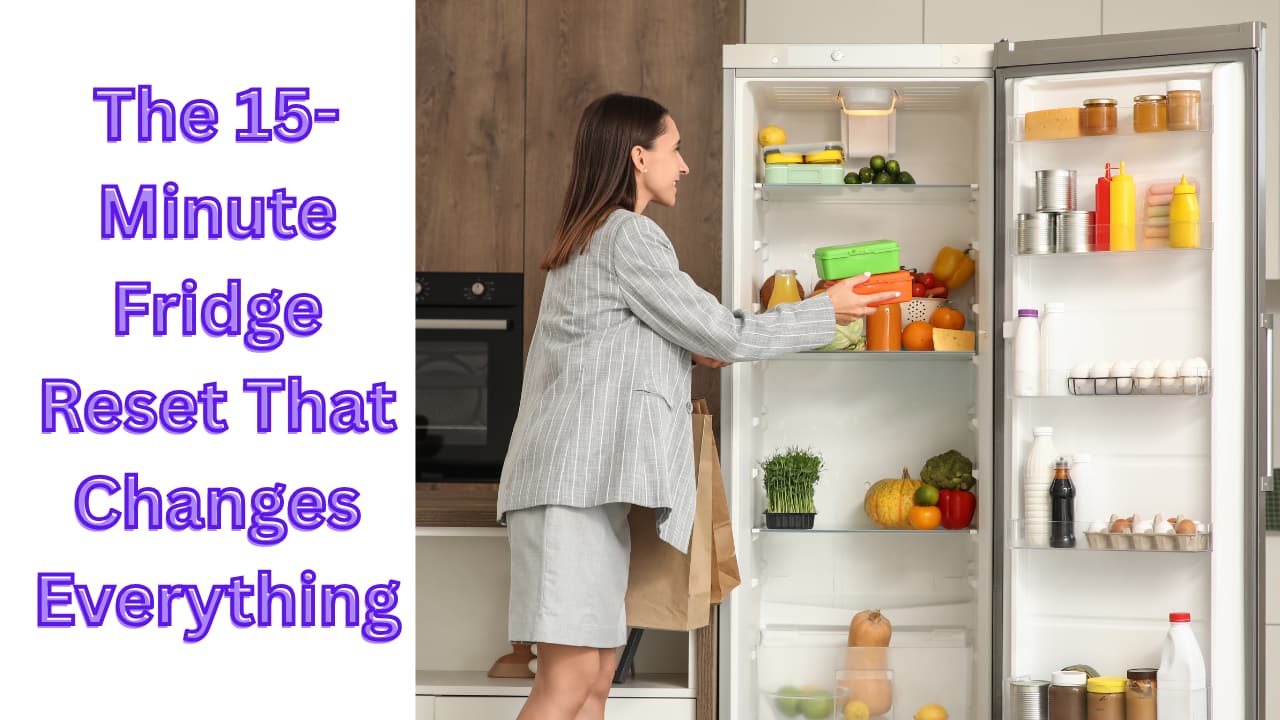 This is the single highest-leverage action in this entire guide. It takes 15 minutes once and about five minutes weekly to maintain. The return on that time investment is extraordinary.
Here is the exact process, step by step.
Step 1: Empty one shelf completely. Start with the main middle shelf, which is prime real estate. Wipe it down. You are creating what restaurant kitchens call a “mise en place” — a designated place for everything with clear visual organization.
Step 2: Establish a “Eat First” zone. The front-left of your eye-level shelf becomes your designated priority zone. Everything that needs to be used within 48 hours goes here. Leftovers, aging produce, open packages. Nothing else lives in this spot.
Step 3: Switch to clear containers for everything. This is the single change with the strongest evidence behind it. OXO Good Grips glass containers (an 8-piece set runs about $58 on Amazon as of early 2026) are my personal recommendation after trying four different brands. The lids seal well, they stack efficiently, and the glass means you can see exactly what is inside from across the kitchen. Rubbermaid Brilliance (around $45 for a similar set) works equally well and is slightly lighter.
Step 4: Add a date label to every container. Buy a roll of blue painter’s tape and a Sharpie. Write the date something was made or opened. Stick it on the container. This removes the guessing game entirely and takes about four seconds per item.
Step 5: Move older items forward before adding new groceries. Every time you put away shopping, older items move to the front. New items go to the back. This FIFO (First In, First Out) system is standard in every professional kitchen on earth. It works.
A reader named Marcus implemented this system in January 2025 after losing $90 in wasted food over the holiday period. He tracked his food spending for the following three months. His waste dropped to under $15 per month. The fridge reset took him 20 minutes. That is roughly $900 in annualized savings from a single afternoon.
How to Shop Smarter Without Spending Hours Planning
Let me challenge the standard meal planning advice here, because most of it sets people up to fail.
A rigid seven-day meal plan with a different recipe every night sounds organized. In practice, it creates a high-failure system. Life interrupts. You end up eating out twice, skipping a night, ordering in and suddenly six planned meals become three, and you have ingredients for six sitting in your fridge going bad.
The better system is what I call flexible scaffolding shopping.
Instead of planning specific meals, you plan cooking categories. Each week, you buy:
- One batch protein (a whole chicken, a large piece of salmon, a pound of ground meat, or a can of chickpeas for plant-based households)
- Two roast-able vegetables (anything that can go in a 400°F oven for 25 minutes)
- One grain or starch (rice, pasta, potatoes, quinoa — your preference)
- One fresh green (whatever looks best and is most affordable that week)
- Pantry staples as needed (eggs, canned tomatoes, broth, olive oil)
From those five categories, you can make eight to ten different meals by varying sauces, spices, and combinations. The chicken becomes roast chicken on night one, chicken and grain bowls on night two, chicken soup with the carcass on day four. Nothing is prescribed. Everything is used.
This system works because it matches your purchase volume to your actual consumption rather than to an idealized version of your cooking ambitions.
For shopping itself: Flipp (free app, iOS and Android) aggregates weekly grocery store flyers and helps you identify what is on sale before you plan your categories. I have used it for 14 months and it saves approximately $25 to $40 per weekly shop by flagging loss leaders at local stores. You build your scaffold around what is affordable and fresh, not around fixed recipes.
The Freezer Strategy That Professional Chefs Use (And Almost Nobody at Home Does)
Your freezer is the most underused appliance in your kitchen. And the way most people use it — as a graveyard for things they intend to cook someday — is precisely the wrong approach.
Professional kitchens freeze at peak quality as a preservation strategy, not as a desperation move. They batch-freeze cooked components, not raw ingredients they are unsure about. This distinction matters enormously.
Here is what freezes brilliantly that most home cooks do not realize:
Cooked grains freeze in individual portions and reheat in two minutes. Rice, farro, quinoa, barley — all of them. Freeze in single-cup portions in zip-lock bags laid flat. You create an on-demand grain station that makes fast weeknight meals possible without the cooking time.
Fresh ginger can be frozen whole and grated directly from frozen using a Microplane. No more buying a large knob of ginger, using one teaspoon, and watching the rest slowly mummify in the back of your vegetable drawer.
Citrus zest freezes beautifully in a small jar. Any time you use a lemon or lime, zest it first before cutting. Store the zest in a labeled freezer jar. You will have months of free citrus flavor available on demand.
Tomato paste possibly the most consistently wasted ingredient in the pantry — freezes perfectly in tablespoon-sized drops on a parchment-lined sheet. Once frozen solid, transfer to a labeled bag. Now you never have to use half a small can and watch the rest go moldy in the fridge.
Overripe avocados (the ones that go from perfect to “past it” in what seems like 45 minutes) can be mashed with a squeeze of lime juice and frozen in portions. They defrost into excellent guacamole base or smooth toast topping.
For freezer organization, the Stack-n-Sort Freezer Bins from YouCopia (around $30 for a set of three on Amazon) dramatically improve visibility and access in standard upright freezers. I spent three years ignoring frozen things because they were buried under other frozen things. These bins solved that.
Preserving Food at Home: What Is Worth Your Time and What Is Not
Preservation has had a major cultural renaissance. Fermentation, pickling, dehydrating — they are everywhere on food social media. And some of these techniques are genuinely worth learning. Others are beautiful distractions that take hours and save you about $3.
Here is an experience-based breakdown.
Quick pickling: absolutely worth it. Takes 10 minutes, requires no special equipment, and transforms vegetables that are two days from going soft into something that lasts three weeks in the fridge. Heat equal parts water and vinegar, add a tablespoon of salt and a tablespoon of sugar, pour over sliced vegetables in a clean jar. Refrigerate. Done. Radishes, cucumbers, red onion, carrots all of them work brilliantly.
Dehydrating: worth it for specific use cases. A basic food dehydrator like the Cosori Premium (around $65 on Amazon) can turn an oversupply of herbs, mushrooms, or fruit into shelf-stable pantry items. If you grow herbs or buy in bulk at farmers markets, this pays for itself quickly. For most standard household use, it is an occasional tool rather than a weekly one.
Full canning and water bath processing: probably not worth your time unless you have a significant garden or buy produce in large volumes. The time investment and equipment cost are substantial. This is the kind of advice that sounds good on paper but leads to one exhausted Saturday session and a shelf of canned tomatoes you never touch because you had to make 24 jars to justify the effort.
Fermentation: high learning curve, high reward. A simple sauerkraut or kimchi fermentation requires only a mason jar and salt. But it does require attention and some willingness to experiment through failure. I ruined three batches before I made one that was genuinely good. The fourth batch was transcendent. If this kind of process appeals to you, The Noma Guide to Fermentation (René Redzepi and David Zilber, 2018) is the most comprehensive and practical resource available.
Understanding Expiration Dates: The Information You Are Not Getting from Packaging
This section might save you $200 a year on its own.
Food date labels in the United States are almost entirely unregulated. That is not an exaggeration. The FDA does not require standardized date labels on most foods. Manufacturers choose their own dates and their own terminology. The result is a system that confuses consumers and contributes to massive waste.
Here is what each label actually means:
“Best if Used By” or “Best By”: This is a quality date, not a safety date. The manufacturer is telling you this is when the product is at its peak. After this date, flavor or texture may decline slightly. The food is almost always still safe to eat.
“Sell By”: This is inventory management information for the store, not consumer guidance. Milk with a sell-by date of today is typically safe to consume for five to seven more days when properly refrigerated. Throwing it away today wastes good food.
“Use By”: This is the one date to take seriously, particularly on fresh meat, poultry, and some dairy products. This reflects actual food safety research rather than quality preferences.
“Freeze By”: An underused gem. This tells you the optimal window for freezing if you cannot use the product in time. It is genuinely helpful and almost universally ignored.
The USDA FoodKeeper app (free, available on iOS and Android) provides evidence-based guidance on how long hundreds of specific foods actually remain safe. It is the most reliable resource I have found and takes the guesswork out of fridge decisions entirely.
One more thing worth knowing: your senses are a reliable food safety tool when used correctly. Fresh meat that has spoiled smells distinctly wrong. Dairy that has gone off changes texture and odor clearly. Learning to trust your nose and eyes rather than a date printed by a liability-averse manufacturer reduces waste and does not increase food safety risk when combined with sensible refrigerator practices.
Composting Without the Complications: A Realistic Assessment
Composting gets romanticized. The reality is messier, in every sense.
Let me give you the honest breakdown of what each approach actually involves.
Countertop collection bins are the entry point. A small stainless container like the OXO Compost Bin ($25, available widely) sits on your counter and collects scraps between trips to a larger bin or municipal pickup. If your city offers curbside organics collection — and in 2026, many major US cities do, including Seattle, San Francisco, New York, and Denver — this is genuinely the easiest and most effective composting solution available. You pay no additional cost. The infrastructure is already there. Use it.
Outdoor tumbler composting is the best option for suburban households with outdoor space. The FCMP Outdoor IM4000 tumbler ($110 to $130) produces finished compost in 60 to 90 days with regular turning and proper balance of greens and browns. The critical failure point for most people is imbalance — too many food scraps and not enough carbon material (cardboard, dried leaves, paper). The ratio should be roughly one part food scraps to three parts carbon. Get this wrong and you get a smelly, slimy mess that puts people off composting permanently.
Electric composters like the Lomi (approximately $400 at lomi.com) and the Vitamix FoodCycler FC-50 (around $350) are the highest-convenience option. Both process food waste in three to eight hours into a dry, soil-like material. The Lomi handles a wider range of inputs including some packaging labeled “Lomi-approved.” The FoodCycler is smaller and quieter. Neither is cheap to run (both use electricity and require replacement filters) but for apartment dwellers or households with high food scrap volumes, they provide a practical solution that traditional composting cannot.
Bokashi fermentation systems handle what traditional compost cannot: meat, fish, dairy, and cooked foods. A basic bokashi kit from SCD Probiotics (around $30 to $40) uses inoculated bran to ferment all food waste into a pre-compost that goes directly into soil. More nuanced to manage than standard composting, but genuinely useful for complete food waste diversion.
One thing I have changed my mind about over the past two years: I used to think composting was essential to any food waste reduction strategy. I now think it is important but secondary. The most impactful thing is not wasting food in the first place. Composting the scraps of food you did use is genuinely valuable. Composting the scraps of food you wasted feels like a consolation prize.
Food Waste Reduction for Specific Households: Tailored Approaches
The advice that works for a single person living alone fails for a family of five. Context matters.
For Single-Person Households
The specific challenge here is portion sizing. Most recipes serve four. Most packaged products are sized for multiple people. The result is constant surplus.
The highest-leverage change: buy from bulk bins wherever available. Whole Foods Market, Sprouts, and many independent grocers have bulk sections where you buy exactly the amount you need — 100 grams of nuts, two tablespoons of a spice, one cup of a grain. No surplus. No waste.
For proteins, a vacuum sealer like the FoodSaver FM2000 (around $60) lets you buy in bulk, portion into single servings, and freeze with minimal freezer burn risk. The seal lasts significantly longer than zip-lock bags, which means frozen items stay genuinely good for six to 12 months rather than deteriorating after eight weeks.
For Families with Children
Involve children in the system. This sounds like a soft suggestion. The data says otherwise. Research published in the journal Appetite in 2020 found that children who participated in meal selection and grocery planning consumed significantly more of the food purchased and expressed greater willingness to eat what was available. Children who chose a meal for the week were invested in seeing it happen.
Create a visible “use-it-up” challenge in the kitchen. A whiteboard on the fridge listing items that need to be eaten first turns waste prevention into a game. Kids engage with challenges in a way they do not engage with instructions.
For Households Where One Person Cooks and Others Eat
This is the most common and least-discussed source of household food waste. The cook plans. Others do not buy in. Food gets made and then not eaten because preferences were not communicated.
A 10-minute Sunday conversation — not a negotiation, just a quick check about what everyone actually wants to eat that week cuts this friction dramatically. It sounds almost absurdly simple. It works because waste in these households is usually a communication problem disguised as a food problem.
The Real Cost of Food Waste: A Number Worth Knowing
Let us make this concrete.
The average American household spends approximately $5,000 to $7,000 on food annually, according to the Bureau of Labor Statistics Consumer Expenditure Survey data from 2024. If 30 to 40 percent of that is wasted, you are looking at $1,500 to $2,800 in annual food waste per household.
For a family earning $75,000 per year, that is two to four percent of gross income going directly into the bin.
Compare that to the investment required to fix it:
- Clear containers: $45 to $60, one-time
- Painter’s tape and markers: $5, recurring annually
- Flipp app: free
- USDA FoodKeeper app: free
- A basic freezer organization system: $30
- 20 minutes of weekly maintenance: your time
Total first-year investment: approximately $100 and about 15 hours of annual time. Against $1,500 or more in savings. The ROI is not close.
Frequently Asked Questions About Stopping Food Waste
How do I stop vegetables from going bad before I use them? Store most vegetables unwashed and dry. Moisture accelerates decay. Leafy greens do better wrapped loosely in a clean paper towel inside a zip-lock bag with a small amount of air left in it. Root vegetables prefer cool, dark, dry storage often not the fridge. Potatoes and onions last longer outside the refrigerator. Herbs store like flowers: trim the stems, place upright in a small glass of water, and cover loosely with a plastic bag in the fridge.
What is the easiest way to use up leftovers consistently? Make leftovers visible and accessible. Clear containers at eye level in the fridge. A “Eat These First” note or whiteboard. The second tactic is planning a weekly “clean-out meal” — typically Thursday or Friday dinner where you deliberately use whatever is in the fridge rather than cooking fresh. This single habit prevents the Friday purge where everything that survived the week gets thrown away.
Is it really worth composting if I am already reducing waste? Yes, but for different reasons. Composting diverts organic material from landfills where it produces methane. It also produces valuable soil amendment if you garden. But composting is not a substitute for reduction it is a valuable supplement. Reduce first, compost what remains.
How do I handle food waste when I travel or work unusual hours? This is where the freezer becomes critical. Before any trip longer than a few days, spend 30 minutes freezing anything that will not last. Batch-cook and freeze two or three meals for the week before a busy period so you have ready options that eliminate the “too tired to cook, ordering pizza” trap.
Can buying cheaper food reduce waste by making it feel less precious? Counter-intuitively, no. Research from the Cornell Food and Brand Lab found that perceived value affects consumption behavior. When we pay more for something, we are more motivated to use it. Buying quality produce you value tends to reduce waste, not increase it. This does not mean waste your money on expensive food — it means buy reasonable quality in amounts you will actually use.
What about food banks — can I donate food instead of composting waste? Absolutely, and this should be mentioned more often. Many food banks accept unopened, unexpired pantry items. Apps like Feeding America’s food bank locator can help you find a nearby location. If you have purchased something you realize you will not use and it is still within its date, donation is always preferable to composting or discarding.
How long do common refrigerator items actually last? Cooked chicken and most cooked proteins: three to four days. Opened dairy like milk and yogurt: five to seven days past the sell-by date if properly sealed. Leafy greens: five to seven days when stored correctly (see first FAQ above). Hard cheeses: three to four weeks after opening. Eggs: three to five weeks from purchase, stored in the original carton toward the back of the fridge (not in the door).
Where to Go From Here: Your First Five Actions
Rachel — the neighbor from the opening of this guide did not overhaul her life. She made five specific changes over six weeks. Her monthly food waste dropped from $127 to under $20.
Here is what she did, in order.
She cleared and reorganized her fridge in one Saturday afternoon. She bought clear containers and a roll of painter’s tape. She downloaded the USDA FoodKeeper app and used it twice before she stopped second-guessing herself. She started shopping from a flexible scaffold rather than a rigid meal plan. She designated Thursday as clean-out-the-fridge night.
That is it. No dehydrator. No fermentation crocks. No elaborate systems. Five friction-reducing changes that made using food easier than wasting it.
Your first move: open your fridge right now and identify what needs to be eaten in the next 48 hours. Move those items to eye level. Label them with today’s date. That action alone, repeated weekly, will change your food waste pattern measurably within a month.
The $1,500 a year is sitting there. The question is whether it funds your food bin or something you actually care about.
What is the one food item you waste most consistently and what has actually helped you use it up? Leave it in the comments. Real answers from real kitchens are worth more than any guide.