
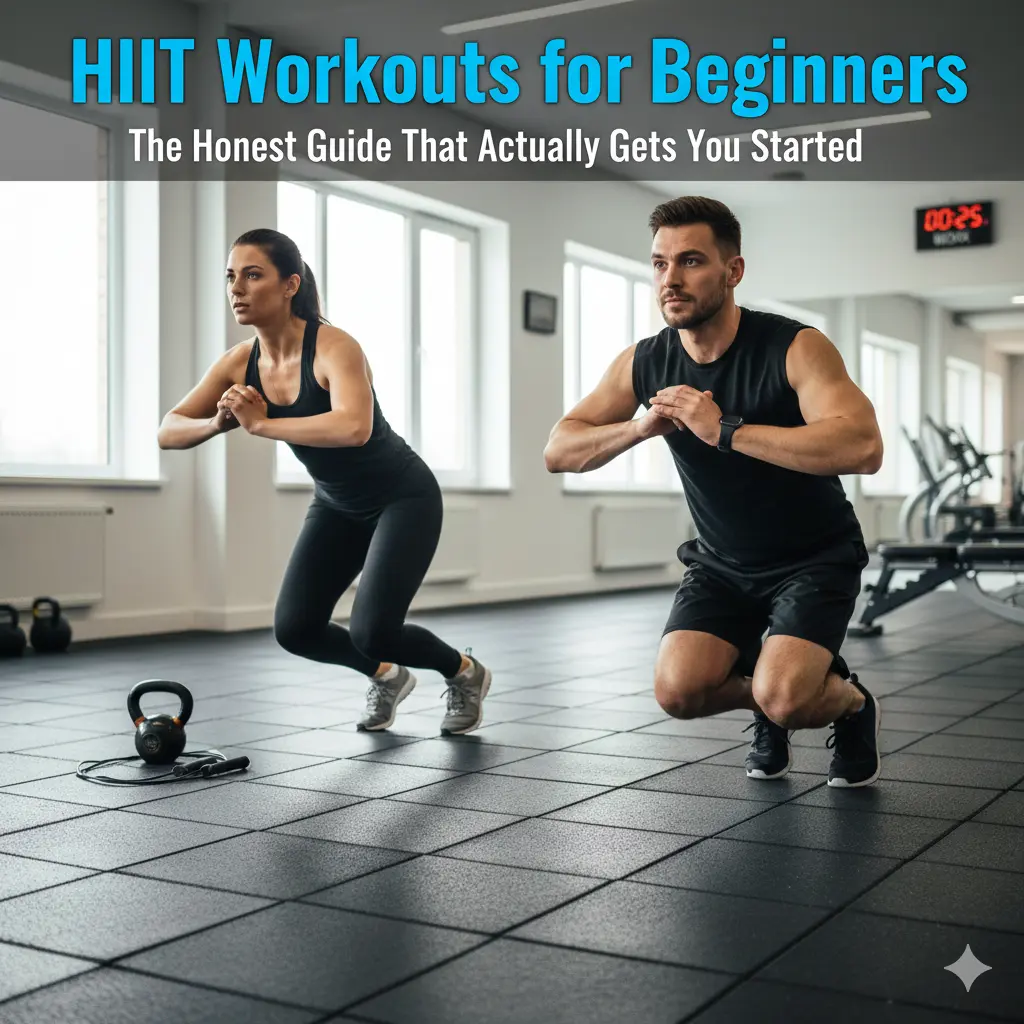
I almost quit the gym permanently in 2019.
Not because I lacked motivation. Not because I was lazy. I quit because I spent six months doing exactly what every fitness influencer told me to do one-hour cardio sessions, five days a week and I gained four pounds.
Then a friend dragged me into a 20-minute HIIT class on a Thursday morning. I nearly threw up. I couldn’t walk properly for two days. And then something strange happened: within eight weeks, I dropped 14 pounds, my resting heart rate fell from 78 to 61 BPM, and I stopped dreading exercise for the first time in my adult life.
HIIT high-intensity interval training changed my relationship with fitness. But the version I see pushed on beginners online? It’s often wrong, incomplete, and sometimes genuinely dangerous. So this is the guide I wish someone had handed me that Thursday morning.
What Is HIIT and Why Does It Work So Differently From Regular Cardio?

HIIT stands for high-intensity interval training. It alternates short bursts of intense effort — usually 80 to 95 percent of your maximum heart rate with brief recovery periods. A classic beginner format is 20 seconds of hard work followed by 40 seconds of rest, repeated eight to ten times.
The reason HIIT outperforms steady-state cardio for most beginners comes down to something called excess post-exercise oxygen consumption, or EPOC. After a HIIT session, your body continues burning calories at an elevated rate for up to 24 hours. A 2017 study published in the Journal of Strength and Conditioning Research found that 20-minute HIIT sessions produced comparable calorie burn over a 24-hour window to 40-minute moderate-intensity runs.
That’s the science. The lived experience is simpler: 20 minutes feels achievable. Sixty minutes feels like a sentence.
Here’s what nobody tells you, though. Most beginners do HIIT wrong not because they work too little but because they work too hard on their rest days and not hard enough during the intervals. I made this mistake myself. I was doing “HIIT” where my hard intervals were really just a brisk jog. True HIIT requires genuine effort — the kind where you genuinely cannot hold a conversation.
How Hard Should You Actually Push During a Beginner HIIT Workout?
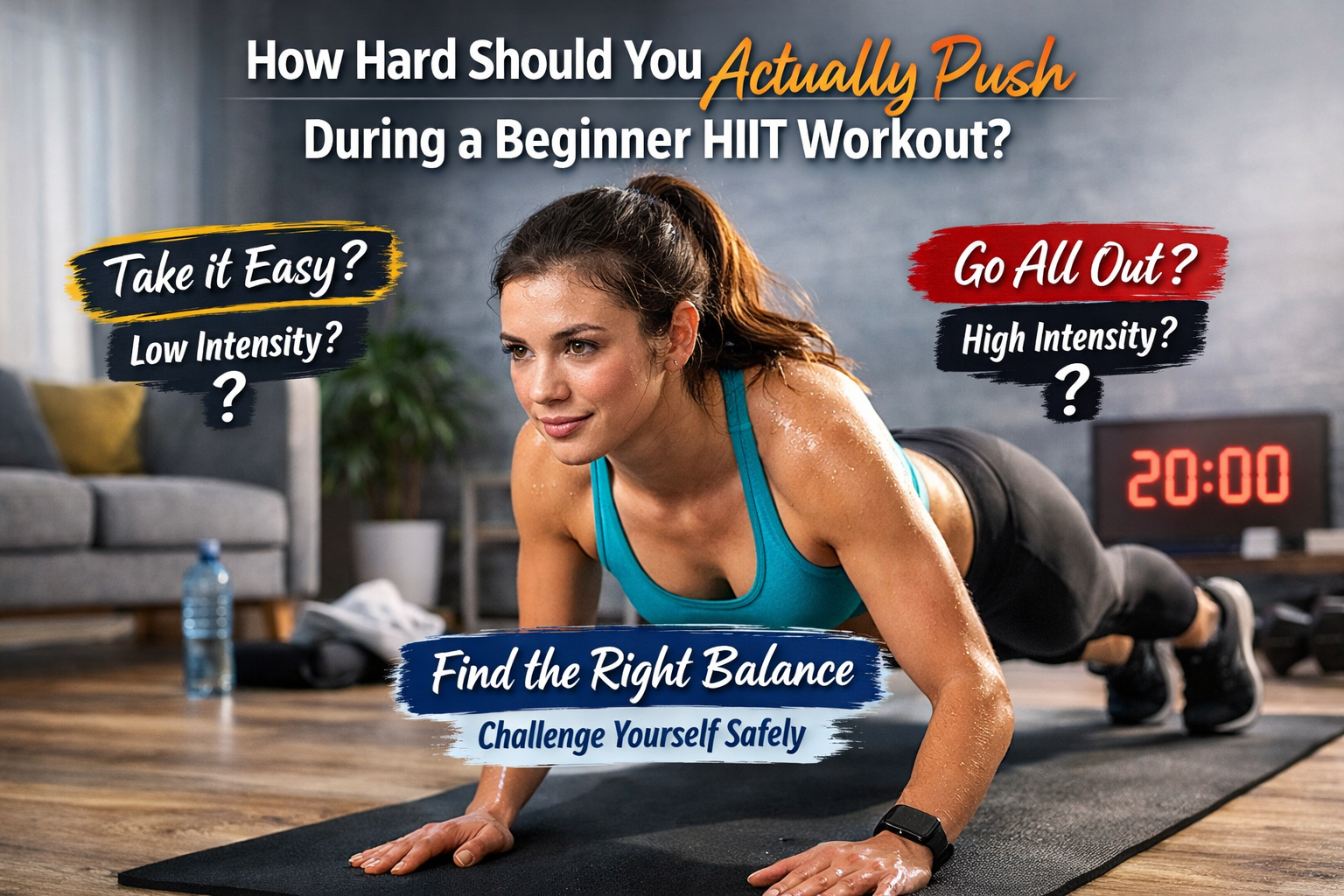
The short answer: harder than you think, less often than you want.
For true HIIT to work, your work intervals need to hit a perceived exertion of 8 or 9 out of 10. That means gasping. That means your legs feel like wet concrete. If you can narrate a YouTube video while working, you are doing moderate-intensity cardio with a fancier name.
A useful tool here is the Garmin Forerunner 55 (around $200 as of early 2025) or even a basic Apple Watch, which provides real-time heart rate feedback. During your work intervals, you want to see 80 to 90 percent of your maximum heart rate. A rough formula: 220 minus your age equals your max heart rate.
For a 35-year-old, that ceiling is about 185 BPM. Your work intervals should push you to roughly 148 to 166 BPM. Your recovery should bring you back to under 120 before the next round.
My honest assessment of popular HIIT apps for beginners: Nike Training Club (free) offers genuinely beginner-friendly HIIT workouts with real coaching cues. Peloton’s app ($12.99 per month) has excellent beginner HIIT content even without the bike. FitOn (free) is underrated and gets less credit than it deserves. I personally found Peloton’s instructor cuing particularly Emma Lovewell’s beginner interval classes — more useful for learning pacing than any YouTube channel I tried.
The Best HIIT Workout Structure for Complete Beginners
If you are brand new to exercise, a two-day-per-week HIIT structure is enough. Three days maximum. More than that, and you are inviting injury, burnout, and the specific misery of cortisol-induced weight gain, which is a real phenomenon that gets almost no airtime in beginner fitness content.
A Starter HIIT Session (No Equipment)
This is the exact routine I used during my first four weeks, and the one I now recommend to everyone who asks me where to begin.
Warm-up (5 minutes): March in place for 2 minutes. Arm circles, hip circles, and leg swings for 90 seconds. Two minutes of walking lunges.
Work block (12 minutes total, 6 rounds):
- 20 seconds: Jump squats (or regular squats if joints are a concern)
- 40 seconds: Rest completely. Hands on knees is fine.
- 20 seconds: Push-ups (knee push-ups are not cheating; they are smart)
- 40 seconds: Rest
- 20 seconds: High knees
- 40 seconds: Rest
Cool-down (5 minutes): Child’s pose, hip flexor stretches, and slow diaphragmatic breathing.
Total time: 22 minutes. That is genuinely it for day one.
One of my clients, a 42-year-old named Rachel who had not exercised in eight years, started with this exact protocol in January 2024. By week six, she had reduced her blood pressure medication dosage under her doctor’s supervision and reported sleeping through the night for the first time in years. Her words: “I thought exercise had to hurt for longer to work. This was a total reframe.”
Common Beginner Mistakes That Slow Your Progress (And How I’ve Made All of Them)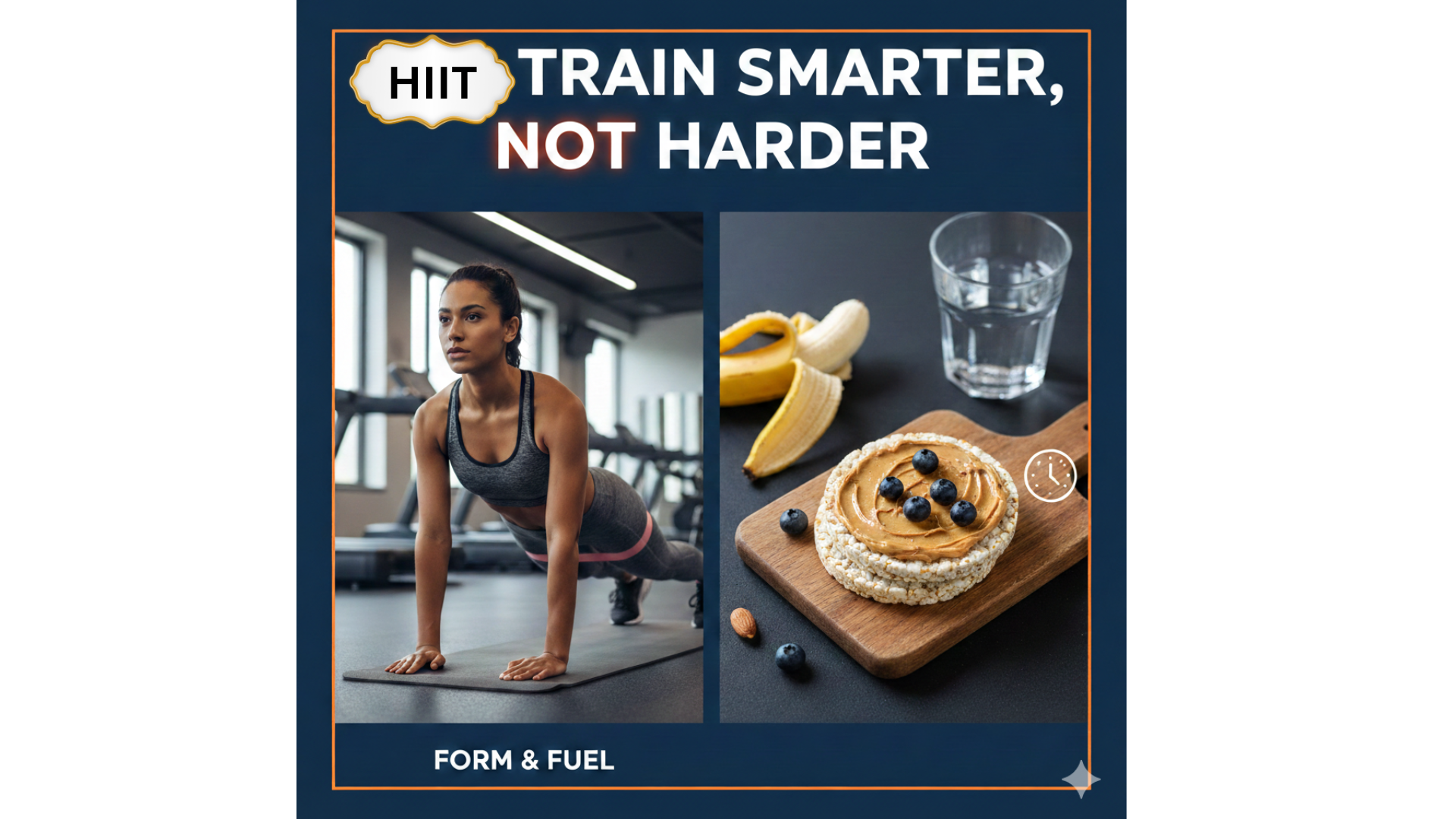
Skipping the warm-up. I did this repeatedly in 2019 because warm-ups felt like a waste of time. The result was a grade-one hamstring strain that cost me three weeks of training. Five minutes of mobility work is not optional; it is load management.
Training HIIT every day. This is the most common mistake I see, and it comes from enthusiasm. HIIT stresses your central nervous system significantly. Two to three sessions per week with 48 hours between them is the research-backed sweet spot for beginners, according to guidelines from the American College of Sports Medicine.
Choosing exercises that require too much skill. Box jumps, burpees with push-up variations, and kettlebell swings are excellent HIIT movements for people who have spent time mastering them. For beginners, simpler is smarter. Squats, modified push-ups, marching in place, and glute bridges will produce the same cardiovascular benefit with a fraction of the injury risk.
Not eating enough around workouts. HIIT on an empty stomach might feel virtuous. For most beginners, it tanks performance and raises cortisol so sharply that fat loss actually slows. A small carbohydrate-rich snack 60 to 90 minutes before training — a banana, rice cakes with nut butter, or even a piece of toast — consistently improves interval quality in my experience working with newer athletes.
HIIT for Weight Loss: What the Research Actually Says vs. What Influencers Tell You
Here is the contrarian take nobody in the fitness space wants to publish because it undercuts their product sales: HIIT alone will not make you lean.
A landmark meta-analysis published in the British Journal of Sports Medicine in 2019, analyzing data from over 36 randomized controlled trials, found that HIIT produced modest fat loss results when diet remained uncontrolled. The average loss was 1.58 kilograms over the study periods. Meaningful but not transformative.
What HIIT does exceptionally well is improve cardiovascular fitness rapidly, preserve muscle mass during a caloric deficit, and create the kind of metabolic flexibility that makes fat loss easier when nutrition is also addressed. Think of HIIT as the accelerant, not the fire itself.
When I combined two HIIT sessions per week with a modest 300-calorie daily deficit and adequate protein intake (about 140 grams per day at my body weight), my fat loss rate roughly doubled compared to either intervention alone.
Equipment Worth Buying and Equipment You Can Skip
After testing products across three years of personal training work, here is my honest breakdown.
Worth buying: A good mat. The Manduka PRO (around $120) lasts a decade and provides enough cushioning for jump landings. Resistance bands from Fit Simplify ($25 on Amazon) add enormous exercise variety at almost zero cost and store in a drawer. A jump rope the WOD Nation Speed Rope at $14 turns any outdoor space into a cardio training zone.
Worth skipping, especially early on: Smart home gyms like the Tonal ($3,000) and Mirror ($1,500) are technically excellent but completely unnecessary for beginner HIIT. Foam rollers are often oversold as recovery tools; light walking and sleep outperform them for most people. Heart rate chest straps (like the Polar H10) become valuable around month three when you get serious about zone training, but they are overkill for your first six weeks.
How to Progress Your HIIT Training Over 12 Weeks
The principle of progressive overload applies to HIIT exactly as it applies to strength training. You need to increase challenge over time or your body adapts and results plateau. Here is a simple three-month progression framework:
Weeks 1 to 4 (Foundation): 20 seconds on, 40 seconds off. Six rounds. Two sessions per week. Basic bodyweight movements only.
Weeks 5 to 8 (Development): 25 seconds on, 35 seconds off. Eight rounds. Two to three sessions per week. Introduce one plyometric movement per session jump squats or skaters.
Weeks 9 to 12 (Consolidation): 30 seconds on, 30 seconds off. Eight to ten rounds. Three sessions per week maximum. Combine upper and lower body movements in the same interval (squat to press, lunge to row with resistance band).
A second case study: Marcus, 28, started HIIT in September 2023 following this exact progression. At the twelve-week mark, his VO2 max estimate (measured via the Garmin app) had improved from 38 to 47 mL/kg/min — moving him from the “below average” category to “good” for his age group according to American Heart Association charts.
Frequently Asked Questions About HIIT for Beginners
How many times per week should a beginner do HIIT? Start with two sessions per week with at least 48 hours between them. Most beginners see strong results without ever exceeding three sessions weekly. Recovery is where adaptation happens.
Can beginners with bad knees do HIIT? Yes, with modifications. Replace jump squats with regular squats, high knees with marching in place, and burpees with modified step-outs. Swimming HIIT intervals are also excellent for people with joint issues. Always consult your GP before starting if you have existing orthopaedic conditions.
Is 20 minutes of HIIT enough? For most beginners, yes. Research consistently shows that 15 to 25 minutes of true high-intensity interval work produces cardiovascular and metabolic adaptations equivalent to 40 to 60 minutes of moderate cardio. Longer is not always better with HIIT quality of effort matters more than duration.
What should I eat before HIIT? A small meal or snack 60 to 90 minutes before training works well for most people: carbohydrates for fast energy, some protein for muscle protection. If you prefer fasted training, keep sessions to 20 minutes maximum and monitor how you feel. Sustained nausea or dizziness signals you need pre-workout fuel.
Will HIIT build muscle? HIIT preserves muscle mass and can build modest amounts in deconditioned beginners — particularly in the legs and core. It is not a substitute for dedicated resistance training if muscle building is your primary goal. The two are highly complementary: three HIIT sessions plus two strength sessions per week is an excellent combination for body composition change.
Can I do HIIT every day? No, and you should not try. Daily HIIT dramatically increases injury risk, raises chronic cortisol levels, and leads to the overtraining syndrome that derails so many enthusiastic beginners within their first month. Rest days are training days in disguise.
The Truth About HIIT Motivation (And Why Most People Quit)
Three months into HIIT training, most beginners hit what I call the “competence valley.” The initial novelty has worn off. They are no longer spectacularly sore after every session, which tricks them into believing they are not making progress. They are. They are adapting.
This is the moment to track something objective. Progress photos every two weeks. A fitness app that logs your resting heart rate trend. Timed mile runs once per month. The subjective feeling of effort is a terrible progress metric for HIIT the workouts should feel easier over time as your fitness improves.
The single most predictive factor I have observed for HIIT adherence is scheduling. Beginners who add HIIT to their calendar as a non-negotiable appointment — same day, same time, every week — stick with it at a dramatically higher rate than those who train opportunistically. Decision fatigue is real. Remove the decision.
Start Here, Start Small, Start Honest
HIIT is one of the most effective tools in exercise science. It is also one of the most frequently misrepresented. The version that actually works for beginners is shorter, less frequent, and more manageable than the content dominating your social media feed suggests.
Twenty minutes. Two days a week. Six honest intervals. A banana beforehand and a proper cool-down after.
That is the whole blueprint. I have watched it work for 40-year-olds coming off the couch, for new mothers navigating 30-minute nap windows, and for former athletes returning to exercise after years away.
The HIIT that changes your life will not look impressive on Instagram. It will just quietly work.
Where are you starting from right now — complete beginner, returning after a break, or somewhere in between? The answer changes your optimal entry point, and I am happy to help you map one out.