By a Certified Fitness Enthusiast and Home Workout Researcher | Updated April 2026
Six months into a gym membership I never used, I canceled it. The gym was twenty minutes away. The parking was terrible. And honestly, by the time I drove there, changed, waited for equipment, and drove back, I had burned ninety minutes for a forty-minute workout. That math does not work.
What I discovered over the next two years of training entirely at home changed my understanding of core fitness completely. You do not need cable machines, ab wheels (well, one exception), or a personal trainer standing over you to build a strong, defined midsection. You need a floor, about 15 square feet of space, and the right exercises in the right order.
Here is the honest truth most fitness content skips: most people doing ab exercises at home are doing them wrong. Not because the exercises are bad, but because they are sequencing poorly, breathing incorrectly, and ignoring the deeper muscle layers that actually create visible definition and functional strength.
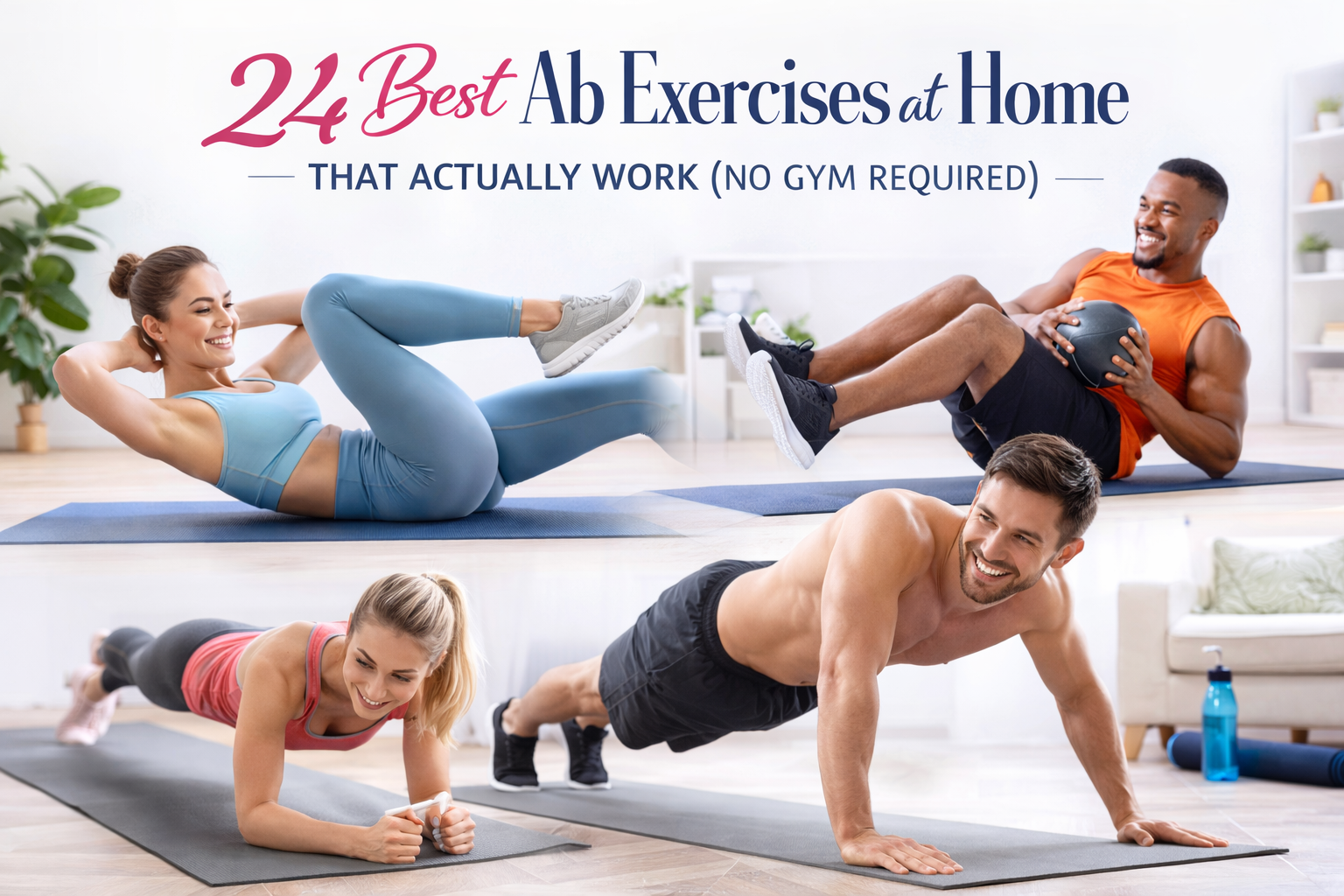
This guide covers the 24 best ab exercises you can do at home. I have organized them by difficulty, explained the mechanics behind each one, and included the specific mistakes I made and watched others make so you can skip the learning curve. No equipment is required for most of them. A few use a yoga mat, a stability ball, or a basic ab wheel, all available for under $30 as of April 2026.
Why Home Ab Exercises Outperform Most Gym Machine Workouts
Here is something your gym membership sales rep will never tell you: the ab crunch machine, the torso rotation station, and the hanging leg raise tower are all designed around fixed movement planes. Your core does not work in fixed planes. It works in three-dimensional space, stabilizing your spine against forces coming from every direction.
A 2019 study published in the Journal of Strength and Conditioning Research compared core muscle activation between machine-based exercises and floor-based bodyweight exercises. Floor exercises, particularly planks, hollow body holds, and dead bugs, produced significantly greater activation of the transverse abdominis, the deepest abdominal muscle and the one most responsible for spinal stability and the appearance of a flat stomach.
Translation: what you can do on your living room floor is genuinely superior to what most gyms offer for core training. The only exception is hanging work, which requires a pull-up bar. A doorframe pull-up bar from Iron Gym or Perfect Fitness costs about $30 and changes your hanging exercise options permanently.
I spent the first year of home training focused entirely on the rectus abdominis, the six-pack muscles. Crunches, sit-ups, leg raises. My abs looked exactly the same for twelve months. The breakthrough came when a physical therapist friend explained that visible definition comes from low body fat combined with a strong, thick transverse abdominis pushing outward. I had been training the surface. She told me to train the foundation.
The 24 Best Ab Exercises at Home, Organized by Difficulty Level
Beginner Ab Exercises (1 through 8)
Start here if you are new to core training, returning from injury, or building a foundation after a long break. These exercises train the deep core stabilizers before loading the superficial muscles.
Exercise 1: Dead Bug
Lie on your back with arms pointing to the ceiling and knees bent at 90 degrees. Slowly lower your right arm behind your head while extending your left leg toward the floor. Hold for two seconds, return, then switch sides. This exercise trains the transverse abdominis without any spinal flexion, making it safe for people with lower back sensitivity. Perform three sets of eight reps per side. When I first added dead bugs to my routine, my lower back pain from desk work reduced noticeably within three weeks.
Exercise 2: Hollow Body Hold
Lie flat, press your lower back into the floor, and raise your legs to 45 degrees while lifting your shoulders slightly off the ground. Arms reach overhead or stay at your sides. Hold for 20 to 30 seconds. This is the foundational gymnastics core exercise. It teaches total-body tension, which carries over to every other ab exercise you do.
Exercise 3: Supine Leg Raise
Lying flat on your back, keep legs straight and raise them to 90 degrees, then lower slowly without letting your lower back arch off the floor. The lowering phase, called the eccentric contraction, builds more strength than the raising phase. Three sets of ten reps. Place your hands under your lower back for support in the early stages.
Exercise 4: Bird Dog
On hands and knees, extend your right arm forward and left leg back simultaneously. Hold for three seconds. Return and switch sides. Bird dog trains the erector spinae alongside the core, making it excellent for overall spinal health. Physical therapist Dr. Stuart McGill, one of the leading spine researchers in the world, specifically recommends bird dog as one of three essential core exercises for spinal health and pain prevention.
Exercise 5: Glute Bridge with Core Brace
Feet flat on the floor, knees bent, brace your abs hard and drive your hips toward the ceiling. At the top, squeeze your glutes and hold your core tight. This is not primarily a glute exercise when done correctly. The core bracing at the top makes it a genuine deep abdominal trainer. Three sets of 15 reps.
Exercise 6: Seated Knee Tuck
Sit on the edge of a chair or on the floor, lean back slightly, and draw your knees toward your chest. Extend them back out without touching the floor. The hip flexors assist here, which some trainers argue against. My take: hip flexors and abs work together in real life. Training them in coordination is not a flaw.
Exercise 7: Standing Oblique Crunch
Standing with hands behind your head, bring your right knee up while dropping your right elbow toward it. Return and alternate. The standing variation reduces spinal load compared to floor-based oblique work. Good for beginners or anyone with lower back issues. Three sets of 12 per side.
Exercise 8: Abdominal Vacuum
Stand or kneel, exhale completely, then draw your navel toward your spine as hard as possible without breathing in. Hold for 15 to 20 seconds. Release and breathe. This exercise specifically targets the transverse abdominis, the muscle responsible for pulling your waistline inward. Bodybuilders used this technique in the 1970s to achieve the dramatically narrow waist visible in classic physique competitors like Frank Zane.
Intermediate Ab Exercises (9 through 16)
These exercises require meaningful core strength and coordination. If you cannot hold a hollow body for 30 seconds or complete 10 clean dead bugs per side, stay at the beginner level for two to four more weeks.
Exercise 9: Plank (Standard and Variations)
Forearms on the floor, body in a straight line from head to heels, hold without sagging or piking. A 2016 study in the Journal of Human Kinetics found that the standard forearm plank activated the transverse abdominis at levels comparable to Swiss ball rollouts. Start at 20 seconds and build toward 90 seconds over eight weeks. The side plank, reached by rotating 90 degrees while keeping one forearm planted, specifically trains the quadratus lumborum and obliques.
Exercise 10: Bicycle Crunch
Lie on your back, hands behind your head, and alternate bringing opposite elbow to opposite knee in a cycling motion. Research consistently shows this as one of the highest-activating exercises for the rectus abdominis and obliques simultaneously. The mistake almost everyone makes: rushing. Slow down. Each rep should take two full seconds. Three sets of 16 alternating reps.
Exercise 11: Mountain Climber
In a high push-up position, drive alternating knees toward your chest as quickly or slowly as your control allows. Faster pace turns this into a cardio and core exercise. Slower pace makes it a pure stability drill. I use a slow version during warm-ups and a fast version for metabolic finishers. Both have distinct value.
Exercise 12: V-Up
Lying flat, simultaneously raise your straight legs and torso to meet in the middle, forming a V shape. Return slowly. This is demanding. Most people compensate by bending their knees or jerking their arms. If you cannot do it cleanly, regress to a tuck-up where knees bend to meet your hands.
Exercise 13: Reverse Crunch
Lie on your back with knees bent and feet off the floor. Roll your hips off the floor by drawing your knees toward your chest, then lower with control. The reverse crunch targets the lower portion of the rectus abdominis more effectively than standard crunches. The lower abs are notoriously difficult to isolate, and this is one of the most reliable methods to do it at home.
Exercise 14: Ab Rollout (Ab Wheel)
Kneeling, hold an ab wheel and roll forward until your body is nearly parallel to the floor, then pull back. This is the single most demanding exercise on this list for the rectus abdominis. A 2018 electromyography study found ab wheel rollouts produced greater muscle activation than any other isolated ab exercise tested. The Perfect Fitness Ab Carver Pro ($30 to $35 as of April 2026) has an internal spring mechanism that makes it slightly more forgiving than basic wheels. Start with half rollouts until you build the strength to go full.
Exercise 15: Toe Touch Crunch
Lie on your back with legs raised to 90 degrees. Reach your hands toward your toes with each crunch, fully contracting the upper abs. The shortened hip flexor position at 90 degrees reduces lower back involvement compared to sit-ups. This is one of the most mechanically clean upper ab exercises available.
Exercise 16: Flutter Kick
Lying flat with hands under your lower back for support, raise both legs about six inches off the floor and alternate kicking them up and down in small movements. Maintain a tight core and pressed lower back throughout. This builds endurance in the hip flexors and lower abs simultaneously. Thirty seconds feels easy. Sixty seconds feels like a lifetime.
Advanced Ab Exercises (17 through 24)
These exercises demand significant strength, body control, and movement awareness. Respect the progression. Jumping to advanced exercises without the foundation leads to compensation, injury, and wasted effort.
Exercise 17: Dragon Flag
Lie on a bench or sturdy table, grip the edge behind your head, and raise your entire body in a straight line off the surface, supporting only your upper back. Lower slowly. Bruce Lee famously used this exercise and it remains one of the most demanding core movements ever devised. The eccentric lowering phase is where most of the strength development happens. Most people cannot do a full dragon flag for months after starting. That is normal.
Exercise 18: L-Sit Hold
On two chairs or parallettes, support your entire bodyweight on your hands and extend your legs straight out in front of you, parallel to the floor. The hip flexors, rectus abdominis, and deep core all work simultaneously under full load. Hold for 5 to 10 seconds to start. Building to 30 seconds over three months is a realistic goal.
Exercise 19: Hanging Knee Raise to Leg Raise
Hanging from a pull-up bar, begin by drawing your knees to your chest. As you progress, straighten your legs and raise them to parallel or beyond. This requires either a doorframe pull-up bar or a ceiling-mounted bar. Iron Gym Total Upper Body Workout Bar ($25 to $35) works for most standard door frames. The hanging position decompresses the spine while intensely loading the abs.
Exercise 20: Windshield Wiper
Lying on your back with arms extended to the sides for support, raise both legs to vertical and rotate them side to side like windshield wipers. The obliques and deep rotational core muscles are the primary targets. Lower the legs toward the floor slowly on each side. Faster rotation reduces the demand significantly.
Exercise 21: Stability Ball Pike
With feet on a stability ball and hands on the floor in a push-up position, draw your hips up and toward the ceiling while rolling the ball toward your hands. This combines core compression with anti-extension, two distinct demands that few exercises address simultaneously. The TRX system ($150 to $180) allows suspension-based pikes without the ball if balance on the ball is an issue.
Exercise 22: Pallof Press (Using Resistance Band)
Anchor a resistance band at chest height, stand perpendicular to the anchor, and press the band straight out from your chest. The core must resist rotation throughout. This anti-rotation exercise targets the obliques and transverse abdominis in a way that no flexion-based exercise can replicate. It mirrors how the core actually works during sports and daily movement. Resistance bands from Fit Simplify or WOD Nation ($15 to $25 per set) are sufficient for this exercise at any level.
Exercise 23: Single-Leg Plank with Hip Extension
In a standard forearm plank, raise one leg slightly off the floor and hold for five seconds. Alternate sides. The asymmetric load forces the obliques and quadratus lumborum to work overtime to prevent rotation. This progression makes the plank far more demanding without any equipment change.
Exercise 24: Full Hollow Body Rock
From the hollow body hold position, rock forward and backward like a rocking chair without changing your body position. Maintaining the hollow shape throughout the rocking motion requires extraordinary tension throughout the entire anterior chain. This is the gymnastic gold standard for core endurance. A consistent 60-second hollow body rock means your core is genuinely strong.
Quick Reference: All 24 Ab Exercises at a Glance
| Exercise | Level | Primary Muscle | Equipment |
| Dead Bug | Beginner | Transverse Abdominis | None |
| Hollow Body Hold | Beginner | Full Core | None |
| Supine Leg Raise | Beginner | Lower Abs | None |
| Bird Dog | Beginner | Deep Core + Back | None |
| Glute Bridge with Brace | Beginner | Deep Core + Glutes | None |
| Seated Knee Tuck | Beginner | Hip Flexors + Abs | Chair (optional) |
| Standing Oblique Crunch | Beginner | Obliques | None |
| Abdominal Vacuum | Beginner | Transverse Abdominis | None |
| Plank | Intermediate | Full Core | Mat (optional) |
| Bicycle Crunch | Intermediate | Rectus + Obliques | None |
| Mountain Climber | Intermediate | Full Core + Cardio | None |
| V-Up | Intermediate | Full Rectus Abdominis | None |
| Reverse Crunch | Intermediate | Lower Abs | None |
| Ab Rollout | Intermediate | Rectus Abdominis | Ab Wheel ($30) |
| Toe Touch Crunch | Intermediate | Upper Abs | None |
| Flutter Kick | Intermediate | Lower Abs + Hip Flexors | None |
| Dragon Flag | Advanced | Full Core | Bench or Table |
| L-Sit Hold | Advanced | Core + Hip Flexors | 2 Chairs |
| Hanging Knee/Leg Raise | Advanced | Lower Abs | Pull-Up Bar ($30) |
| Windshield Wiper | Advanced | Obliques + Deep Core | None |
| Stability Ball Pike | Advanced | Core + Shoulders | Stability Ball ($20) |
| Pallof Press | Advanced | Anti-Rotation Core | Resistance Band ($20) |
| Single-Leg Plank | Advanced | Obliques + Stabilizers | None |
| Hollow Body Rock | Advanced | Full Anterior Chain | None |
How to Structure These Exercises Into an Actual Weekly Routine
Knowing 24 exercises means nothing without a plan. Here is the exact weekly structure I used when rebuilding my core after two years of neglect following a back injury in late 2022.
Beginner Weekly Plan (4 Weeks)
Three days per week, nonconsecutive. Each session takes 15 to 20 minutes.
- Dead Bug: 3 sets of 8 per side
- Hollow Body Hold: 3 sets of 20 seconds
- Bird Dog: 3 sets of 8 per side
- Glute Bridge with Brace: 3 sets of 15
- Abdominal Vacuum: 3 sets of 15 seconds
Intermediate Weekly Plan (Weeks 5 through 12)
Four days per week. Sessions run 20 to 30 minutes.
- Plank: 3 sets of 45 seconds
- Bicycle Crunch: 3 sets of 16
- Reverse Crunch: 3 sets of 12
- Ab Rollout: 3 sets of 8 to 10
- Flutter Kick: 3 sets of 45 seconds
Advanced Weekly Plan (Week 13 onward)
Five days per week with two active rest days. Sessions run 25 to 35 minutes.
- Hollow Body Rock: 3 sets of 45 seconds
- Dragon Flag: 3 sets of 5 to 8
- Hanging Leg Raise: 3 sets of 10
- Pallof Press: 3 sets of 10 per side
- L-Sit Hold: 4 sets of 10 seconds
The Most Damaging Mistakes People Make With Home Ab Training
I made every one of these. I watched dozens of others make them in online fitness communities I was part of. These are not minor technical errors. They are the reason most people do ab exercises for six months and see zero change.
- Training abs every single day. The abs are muscles. Muscles recover and grow during rest, not during training. Train your abs three to five days per week maximum, with at least one full recovery day between sessions.
- Doing only crunches. The crunch trains approximately 30 percent of your total core musculature. Doing only crunches is like doing only bicep curls and expecting your whole arm to grow.
- Holding your breath. Every ab exercise should involve deliberate breathing. Exhale on the effort, inhale on the return. Held breath spikes internal abdominal pressure in ways that can stress the pelvic floor and lower back.
- Ignoring the lower back. The core is a cylinder. Training only the front while neglecting the back creates muscular imbalances that cause injury. Bird dog, superman holds, and back extensions belong in any complete core routine.
- Relying on neck momentum in crunches. If your neck is sore after ab training, you are pulling with your neck instead of contracting with your abs. Place your tongue on the roof of your mouth during crunches. It sounds strange but it genuinely reduces neck tension.
- Skipping progressive overload. The abs adapt to the same stimulus quickly. After four weeks, increase reps, sets, difficulty, or load. Without progression, results plateau.
Frequently Asked Questions About Ab Exercises at Home
How long does it take to see results from home ab exercises?
Visible abdominal definition depends primarily on body fat percentage, not just muscle development. Most people begin to feel functional strength improvements within two to four weeks. Visible definition typically requires reaching 15 percent body fat or below for men and 20 to 24 percent or below for women. The training timeline to see visible abs varies enormously based on diet and starting body composition. The ab exercises build the muscle. Diet creates the visibility.
Do I need any equipment for effective home ab training?
For the first 16 exercises on this list, you need absolutely nothing except a floor. For maximum development, a $25 ab wheel, a $30 pull-up bar, and a $20 resistance band cover nearly every advanced exercise. Total investment under $75. Compare that to a gym membership at $40 to $80 per month and the math strongly favors home training.
Is it better to train abs in the morning or evening?
The research does not strongly favor either time for muscle development. What matters most is consistency. My personal preference is morning, specifically because morning training requires no willpower negotiation at the end of a long workday. The best time to train abs is the time you will actually do it reliably.
Can I do ab exercises if I have lower back pain?
Yes, with the right selection. Dead bugs, bird dogs, abdominal vacuums, and gentle hollow body holds are all considered safe and even therapeutic for most lower back conditions. Avoid spinal flexion exercises like crunches and sit-ups during flare-ups. Always consult a physical therapist or physician if your back pain is severe, recent, or related to a known injury.
Why do I feel my hip flexors more than my abs during leg raises?
Hip flexor dominance during leg raises is one of the most common complaints in ab training. The fix is deliberate pelvic tilting. Before raising your legs, posteriorly tilt your pelvis by pressing your lower back firmly into the floor. This shortens the rectus abdominis and positions it to bear more of the load. It takes practice but changes the exercise completely.
How many reps and sets should I do for abs?
The abs respond well to both higher rep endurance work (15 to 30 reps) and lower rep strength work (5 to 10 reps for weighted or advanced exercises). A complete program includes both. The common mistake is doing endless high-rep crunches while never challenging the abs with progressive resistance or more demanding movement patterns.
Are sit-ups bad for your back?
Full sit-ups, which involve spinal flexion through the lumbar region under load, are not ideal for people with disc issues or lower back sensitivity. Dr. Stuart McGill’s research at the University of Waterloo has shown that repeated loaded spinal flexion can contribute to disc damage over time. For most healthy people, occasional sit-ups are fine. But crunches, reverse crunches, and the exercises in the beginner and intermediate sections of this guide are more biomechanically sound for long-term practice.
Can women do the same ab exercises as men?
Yes. The core anatomy is essentially identical between sexes. The progression, starting weights, and specific modifications around pregnancy or postpartum recovery differ, but the exercises themselves are universally applicable. The transverse abdominis activation work in this guide is specifically important for postpartum women rebuilding their core after pregnancy.
Building the Core You Want Starts With These 24 Exercises
Two years ago I trained my abs on a gym floor surrounded by machines I could not use efficiently. Today I train in a 10-foot by 10-foot corner of my apartment with a $25 ab wheel, a $30 pull-up bar, and a yoga mat, and my core is stronger than it has ever been.
The 24 exercises in this guide represent a complete system. Start at the beginner level regardless of how fit you think you are. The foundational exercises reveal weaknesses that more impressive-looking movements mask. Build progressively. Respect recovery. Train consistently four to five days per week.
The industry is moving toward more functional core training in 2026 and beyond. Anti-rotation exercises, three-dimensional stability work, and breath-based training are replacing the crunch-centric approach that dominated fitness culture for decades. This guide already reflects that evolution. You are ahead of the curve.
My specific recommendation for this week: pick three exercises from the beginner section and do them for seven consecutive days. Just three. Learn the movement patterns before adding volume. In four weeks, assess your strength and move to intermediate.
One question I genuinely want your answer to: which of these 24 exercises surprised you most, either because you had not heard of it or because you tried it and found it harder than expected? The answers in communities I am part of always reveal the exercises that deserve more attention, and that shapes what I cover next.
Note: Consult a qualified fitness professional or physician before beginning any new exercise program, particularly if you have existing back, hip, or abdominal conditions.